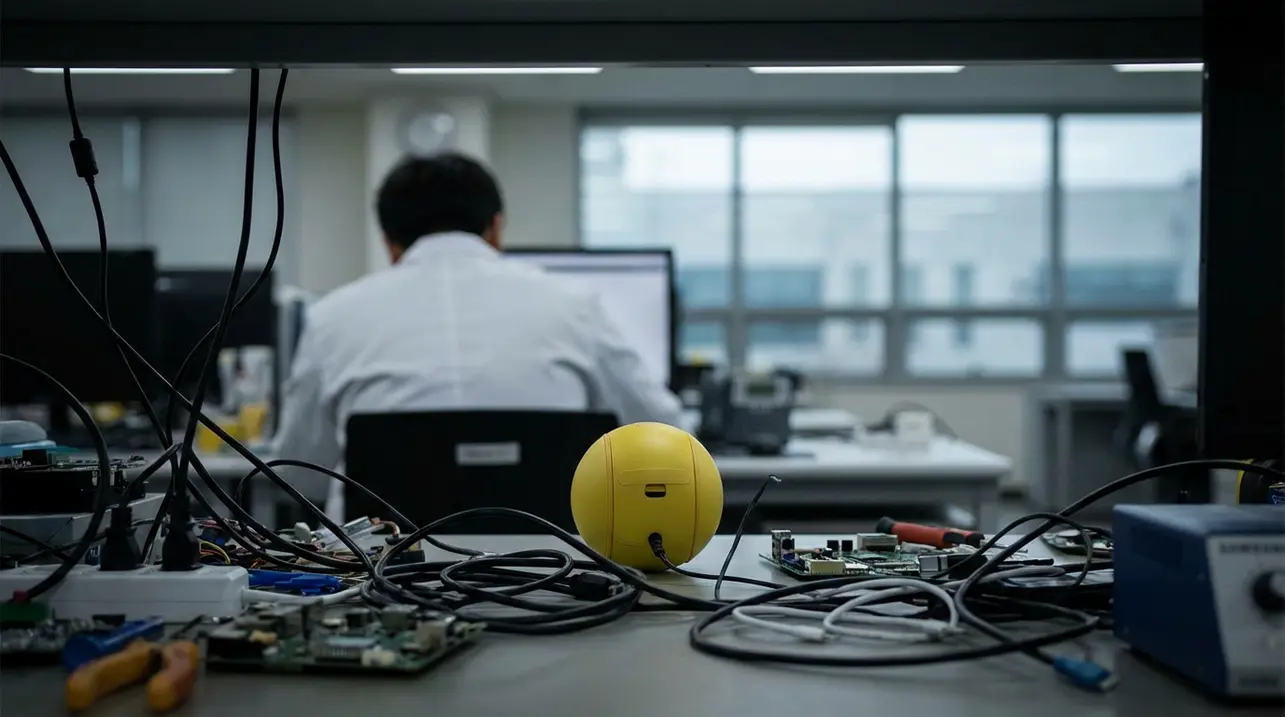
Samsung demotes Ballie home robot to internal use.
DADaniel Reed5 months ago7 min read
In a move that speaks volumes about the chasm between flashy tech demos and commercially viable products, Samsung has quietly relegated its once-celebrated Ballie home robot to internal use, a full six years after its star-making debut at CES. This isn't merely a product delay; it's a strategic demotion that echoes a familiar pattern in the AI and robotics industry, where ambitious prototypes designed to capture headlines often stumble when confronted with the hard realities of manufacturing, cost, user utility, and the relentless march of underlying technology.Ballie, you'll recall, was the charming, rolling orb Samsung unveiled in 2020, promising a future where a personal, mobile AI companion would manage smart home devices, project interfaces onto your floor, and even keep an eye on your pets. It was a vision straight out of science fiction, a tangible representation of ambient computing.Yet, that vision has now been shelved, not for consumers, but for the company's own R&D corridors. This decision forces us to ask a critical question: what does it take to transition an AI-powered robot from a captivating proof-of-concept to a must-have household appliance? The challenges are multifaceted.First, the hardware hurdle: creating a small, mobile, durable robot with sufficient processing power, battery life, and sensor fidelity (like the necessary cameras for its promised functions) at a consumer-friendly price point is a monumental engineering feat. Second, the software and AI challenge: the robot needs robust, context-aware AI that can reliably navigate dynamic home environments, understand natural language commands, and proactively offer useful assistance without being intrusive or gimmicky.Third, and perhaps most crucially, is the question of core utility. Does Ballie solve a problem acute enough to justify its inevitable four-figure price tag, or was it a solution in search of a problem? Many early adopters of home robots have found them to be novelties that wear off quickly, gathering dust after the initial fascination fades.Samsung's pivot suggests they've concluded the market isn't ready, or that Ballie's specific value proposition isn't yet sharp enough. This mirrors the journeys of other high-profile robotics projects.Google, for instance, famously struggled with its Boston Dynamics acquisition before selling it, and even Amazon's Astro has faced skepticism regarding its practical use beyond being a mobile Echo Show. The shift to internal use is telling; it implies Samsung sees continued value in the platform as a testbed for AI interaction models, sensor fusion, or home automation protocols, but not as a standalone product.It becomes a tool for gathering data and refining technologies that may later surface in other, perhaps less anthropomorphic, forms. From an AI development perspective, this is a pragmatic, if disappointing, outcome.It underscores a maturation in the industry's approach. The era of launching half-baked AI products to capitalize on hype is giving way to a more measured, iterative process.The compute and algorithmic demands for a truly useful domestic robot are still enormous, likely requiring more efficient edge AI models and more sophisticated multimodal understanding than are currently available at scale. Samsung's move could be read as a strategic patience, waiting for the underlying AI infrastructure—the large language and action models that could give Ballie a genuinely useful personality and capability set—to catch up to the hardware vision.The consequence is a reaffirmation that the home robotics market remains a graveyard of great ideas before their time. It doesn't mean Ballie, or its concept, is dead forever.It means that for now, the economic and technological equation doesn't balance. For consumers, it's a reminder that the CES stage is a theater of potential, not a promise of imminent delivery. For the industry, it's a case study in the difficult pivot from visionary prototype to viable product, a lesson in the sobering calculus of real-world AI deployment where feasibility ultimately trumps fascination.
#Samsung
#Ballie
#home robot
#CES
#internal use
#robotics
#consumer electronics
#lead focus news