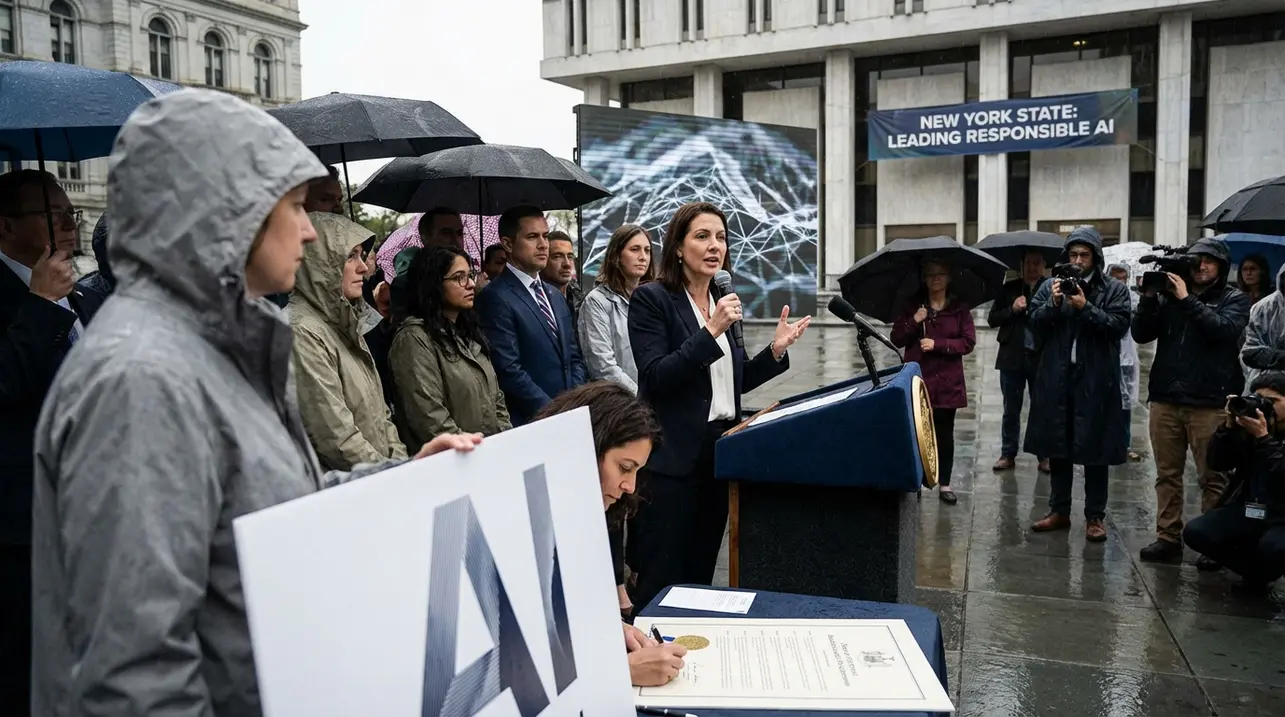
New York Governor Signs AI Safety Regulation Bill
In a move that signals a decisive shift from theoretical debate to tangible governance, New York Governor Kathy Hochul has signed into law a pioneering AI safety regulation bill, setting a precedent that could ripple across the nation and recalibrate the global conversation on artificial intelligence oversight. The legislation, which mandates that large-scale AI developers operating within the state must publicly disclose their safety protocols and report any significant safety incidents to authorities within a stringent 72-hour window, is not merely a bureaucratic footnote; it is a foundational stone in the architecture of our shared technological future, echoing the precautionary principles long championed in science fiction but rarely enacted in policy.This action places New York, a global financial and tech hub, at the vanguard of a fraught regulatory landscape, directly challenging the prevailing 'move fast and break things' ethos of Silicon Valley with a more measured, safety-first approach reminiscent of Asimov's First Law of Robotics—a robot may not injure a human being or, through inaction, allow a human being to come to harm. The bill's core requirements are deceptively simple yet profoundly consequential: by forcing transparency, it aims to pierce the veil of corporate secrecy that often shrouds the development of frontier models, compelling companies to articulate their risk assessment frameworks, data governance policies, and mitigation strategies for potential harms ranging from algorithmic bias and disinformation campaigns to catastrophic alignment failures.The 72-hour incident reporting clause is particularly significant, establishing a legal duty of care that parallels reporting requirements in sectors like finance or aviation, thereby formally acknowledging that AI systems can pose systemic risks on par with critical infrastructure. Proponents, including a coalition of AI ethicists and consumer advocacy groups, hail the law as a necessary corrective to the unchecked acceleration of AI capabilities, arguing that public trust is the ultimate currency of technological adoption and that such guardrails are essential to prevent a regulatory race to the bottom.They point to historical precedents where delayed intervention—from the early days of social media's impact on democracy to the slow regulatory response to financial derivatives—led to profound societal harm, suggesting that proactive, adaptive regulation is the only responsible path forward. However, the law has ignited fierce opposition from segments of the tech industry and libertarian policy circles, who warn that it could stifle innovation, drive development underground or to more permissive jurisdictions, and create a compliance burden that only the largest, best-resourced companies can bear, ironically cementing the market dominance of the very giants it seeks to regulate.Critics also question the practicalities of defining a 'safety incident' with the precision required for legal enforcement and the potential for over-reporting to create a cacophony of minor issues, obscuring genuine threats. The bill's passage coincides with a fragmented global regulatory environment, where the European Union is implementing its comprehensive AI Act with a risk-based taxonomy, China has focused on algorithmic recommendation governance, and the U.
#ai safety
#regulation
#new york
#raise act
#legislation
#compliance
#featured