

AIroboticsAI for Manufacturing
How Robotics Could Turn E-Waste Into a Tech Goldmine
KE
Kevin White
6 months ago7 min read
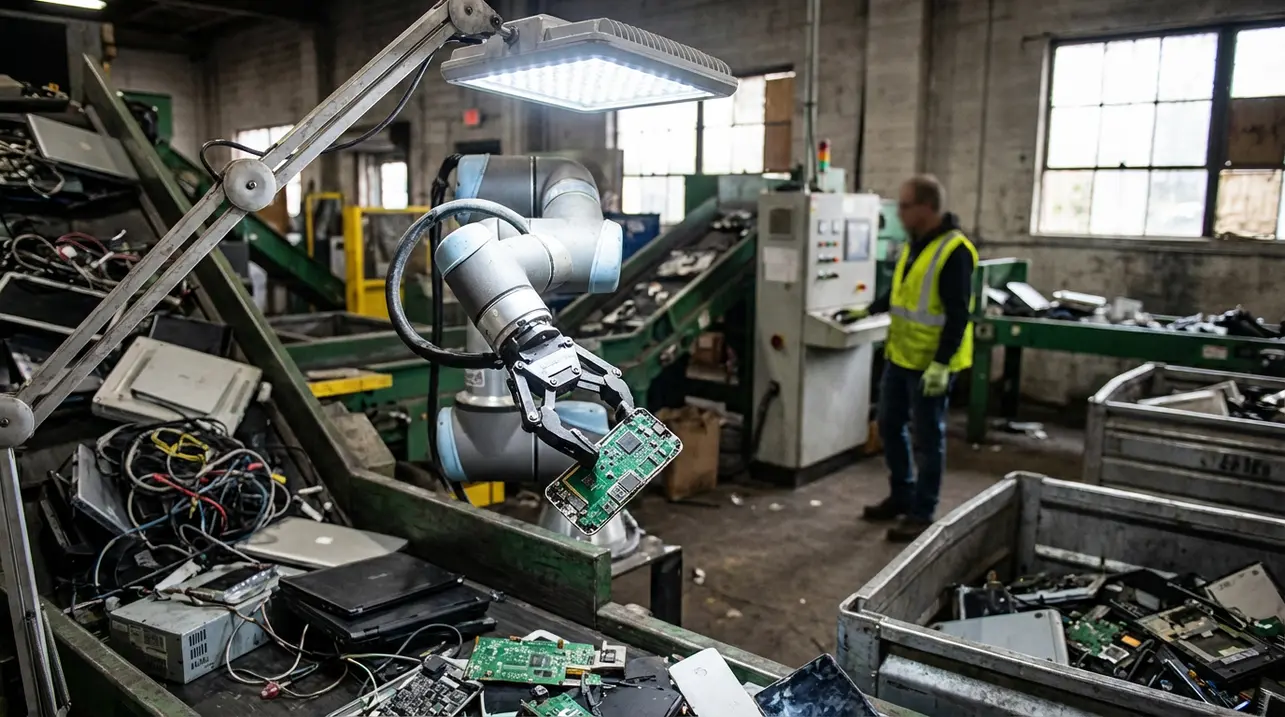
The staggering volume of electronic waste clogging our landfills and poisoning informal recycling yards across the globe represents not just an environmental catastrophe, but a colossal failure of resource logistics. We’re sitting on a tech goldmine, buried in toxic trash.The numbers are as familiar as they are grim: a United Nations forecast of 80 million tonnes by 2030, a line of trucks that could circle the Earth, and the damning statistic that nearly 80% of our discarded gadgets never see a proper recycling facility. In 2024 alone, over 1.22 billion smartphones were produced, feeding a saturated market built on a throwaway cycle that feels both economically irrational and ecologically suicidal. The traditional manual disassembly of this e-waste is a dangerous, inefficient dead end, exposing workers in developing nations to a cocktail of heavy metals and hazardous chemicals for meager returns.This is where the narrative must pivot from problem to solution, and the most compelling answer lies not in policy pamphlets alone, but in the precise, untiring arms of robotics and artificial intelligence. Imagine a facility where a robotic arm, guided by advanced computer vision and machine learning algorithms, can identify, sort, and disassemble a discarded iPhone, a laptop, or a circuit board with surgeon-like accuracy.These systems can be trained to recognize hundreds of device models, locate specific components like lithium-ion batteries or gold-plated connectors, and execute the disassembly process far faster and safer than any human hand. The potential here is transformative.It moves recycling from a crude, bulk-material recovery operation into a high-precision recovery of critical, high-value elements. We’re talking about gold, silver, palladium, and copper, but also the so-called ‘technology-critical elements’ like neodymium from magnets, indium from touchscreens, and cobalt from batteries—materials essential for the very next generation of electronics, electric vehicles, and renewable energy systems that are supposed to be our green future.This isn't just cleaning up a mess; it's closing the loop on the materials economy, creating a domestic and secure supply chain for industries currently dependent on geopolitically tense mining operations. The technical challenges are non-trivial, of course.The variation in device design is immense, and the robots must be incredibly adaptable. But this is where the fusion of AI and robotics shines.Through continual learning, these systems can improve their recognition and manipulation strategies, turning each piece of e-waste into a data point that refines the process. The economic calculus begins to shift dramatically when you factor in the recovered value of these materials, the reduced health and liability costs, and the potential for automated systems to operate around the clock.Pilot projects, like those hinted at in Denmark, are the crucial proving grounds. The broader context is one of urgent necessity meeting technological maturity.We have the tools. The question is whether we have the collective will to invest in and scale this robotic reclamation, transforming our linear ‘take-make-dispose’ model into a circular, intelligent recovery system.The consequence of inaction is clear: a planet increasingly burdened by toxic waste and resource scarcity. The consequence of embracing this tech-driven path is a future where our old gadgets literally build our new ones.
#robotics
#e-waste
#recycling
#automation
#sustainability
#lead focus news
Stay Informed. Act Smarter.
Get weekly highlights, major headlines, and expert insights — then put your knowledge to work in our live prediction markets.
Related News











2 months ago
Trump wants to stop states from regulating AI

2 months ago
Canva Repositions as an AI Platform with Design Tools

2 months ago
Billy Corgan and Diplo debate AI use in music industry.

2 months ago
Black Forest Labs' Self-Flow makes AI training 2.8x more efficient

2 months ago
Meta and Broadcom Extend AI Chip Partnership to 2029
Comments
It's quiet here...Start the conversation by leaving the first comment.