AIchips & hardwareAMD and Intel AI Chips
CES 2026: AMD Shows 'Helios' Hardware for AI Content Feeds
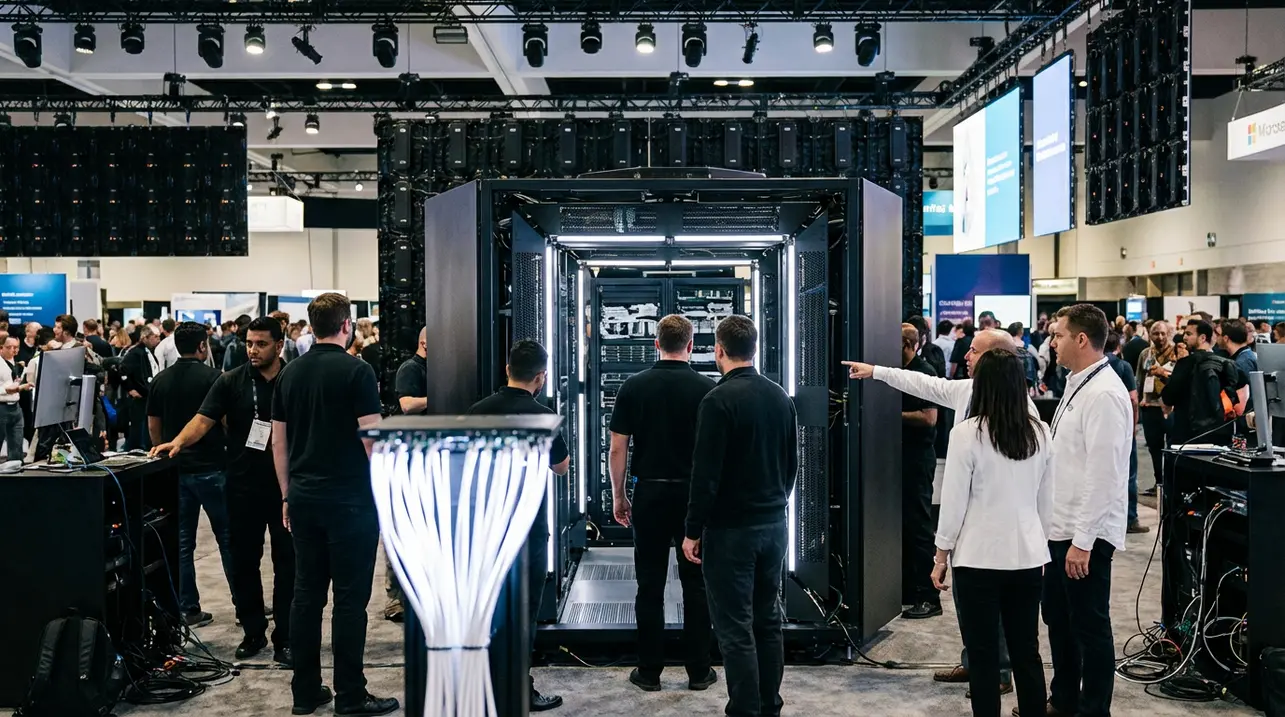
At CES 2026, AMD’s unveiling of its 'Helios' hardware platform, touted as 'the world's best AI rack,' represents far more than a typical product launch; it’s a strategic gambit in the escalating infrastructure war that will define the next phase of artificial intelligence. To understand its significance, one must look beyond the marketing superlatives and into the architectural nuances.Helios isn't merely a collection of powerful accelerators; it's a holistic, systems-level approach designed to tackle the most persistent bottleneck in large-scale AI: the inefficient movement of data between compute, memory, and storage. By integrating their latest Instinct accelerators, custom interconnects, and a unified software stack co-developed with major cloud hyperscalers, AMD is directly challenging Nvidia’s dominant DGX pod paradigm.The promise is a radical improvement in throughput and energy efficiency for training frontier models and, more critically, for serving the real-time, multi-modal AI content feeds that are becoming the nervous system of the digital economy. This move is deeply rooted in the industry's trajectory.For years, the AI race focused on raw FLOPs, but as models grew exponentially, the von Neumann bottleneck became the primary constraint. AMD’s acquisition of Xilinx and its subsequent work on adaptive SoCs and high-bandwidth memory (HBM3e) laid the groundwork for Helios.The platform likely leverages chiplet technology to offer unprecedented scalability, allowing data centers to build disaggregated pools of AI-optimized compute that can be dynamically allocated, a move away from the rigid, monolithic server racks of the past. Experts I’ve spoken to, including researchers at institutions like the Stanford HAI, note that while Nvidia’s CUDA ecosystem remains a formidable moat, the industry’s desperation for cost-effective, non-proprietary alternatives has never been higher.Helios’s open software approach, built on ROCm and compatible with frameworks like PyTorch, is a direct appeal to this sentiment. The consequences are profound.If successful, Helios could democratize access to state-of-the-art AI infrastructure, lowering the barrier for entry for startups and academic labs and potentially accelerating innovation outside the walled gardens of a few tech giants. However, it also raises critical questions about the sustainability of an AI boom predicated on ever-larger models consuming gargantuan amounts of power and water for cooling.AMD’s emphasis on efficiency is a nod to this concern, but the environmental footprint of a global network of Helios-powered data centers remains a serious, and often glossed-over, policy challenge. Furthermore, the geopolitical dimension is inescapable.With export controls on advanced semiconductors tightening, the design and manufacturing provenance of every component in the Helios stack will be scrutinized. AMD’s ability to secure a resilient supply chain for its chiplets, potentially leveraging foundries beyond TSMC, will be as crucial to its adoption as its technical benchmarks.In essence, the Helios announcement is a declaration that the future of AI will be written not just in algorithms, but in silicon, systems architecture, and software ecosystems. It signals a shift from a single-vendor hardware monopoly to a more contested, heterogeneous landscape.The real test will come in the coming quarters as early adopters in cloud and enterprise settings put these racks through their paces on production workloads. Will Helios deliver on its promise of seamless, scalable performance, or will it stumble on the immense complexities of real-world deployment? The answer will determine whether 2026 is remembered as the year the AI infrastructure market truly became competitive.
#CES 2026
#AMD Helios
#AI hardware
#AI infrastructure
#AI data centers
#AI chips
#lead focus news