

AIresearch & breakthroughsScientific Discovery via AI
2025's AI-fueled scientific breakthroughs across health, robotics, and climate
KE
Kevin White
5 months ago7 min read
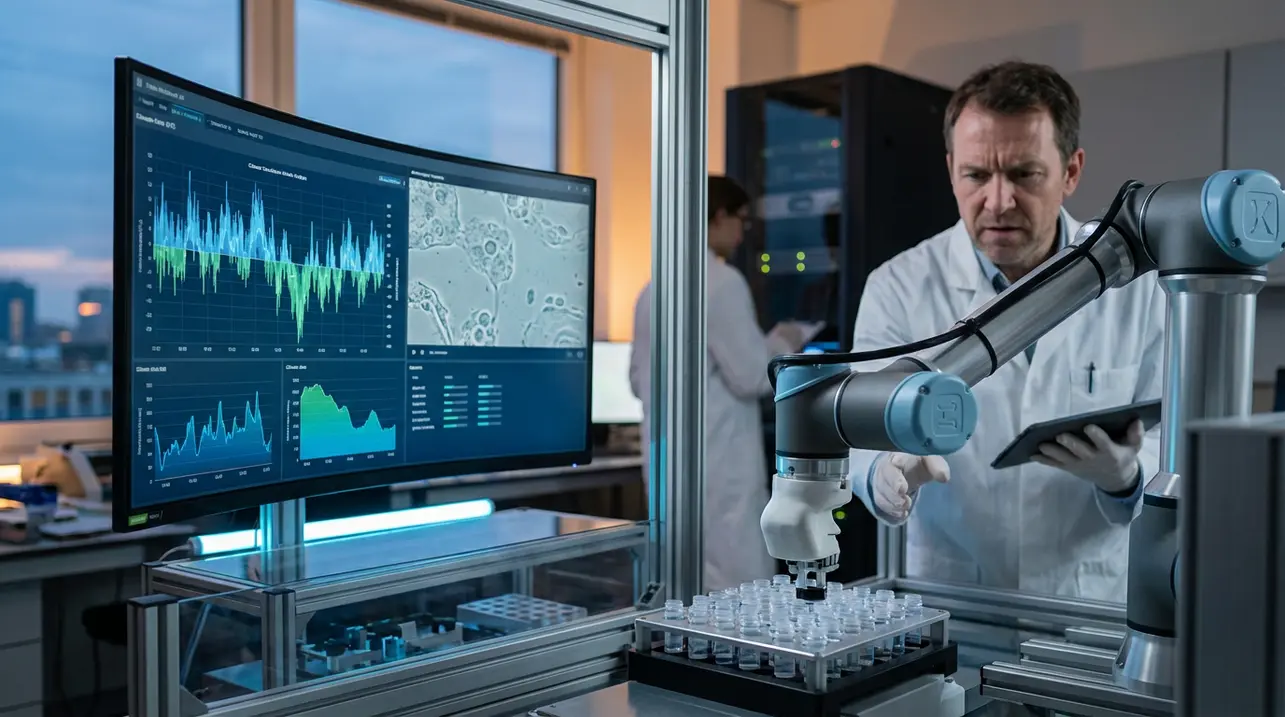
The year 2025 has solidified itself not merely as another chapter in technological progress, but as a definitive inflection point where artificial intelligence transitioned from a powerful tool to the central architect of scientific discovery. Across the sprawling domains of health, robotics, and climate science, AI-driven innovation has accelerated at a pace that is reshaping fundamental methodologies, compressing decade-long research timelines into months, and placing private-sector giants like Google, Microsoft, and a new breed of well-funded startups at the helm of what can only be described as a new scientific revolution.This momentum is fueled by a staggering private investment landscape that exceeded $109 billion in 2024, dwarfing the U. S.federal government's $3. 3 billion in non-defense AI R&D for 2025, a disparity that underscores a significant shift in where the cutting edge is being forged.In healthcare, the impact is profoundly personal and immediate. The long, arduous, and often heartbreaking diagnostic odyssey for neurodegenerative diseases like Alzheimer's is being radically streamlined.Researchers at institutions like Indiana University's Regenstrief Institute have demonstrated how AI can enable faster, cheaper detection in primary care settings, potentially bringing critical early intervention to millions. Even more groundbreaking was a study from UC San Diego, where AI was instrumental in visualizing the complex three-dimensional structure of a protein, leading to the identification of a specific gene as a definitive cause of Alzheimer's—a discovery that would have been nearly impossible with traditional techniques alone.This builds directly on the Nobel Prize-winning legacy of DeepMind's AlphaFold2 from five years prior, a tool that has become foundational. Google's subsequent release of AlphaGenome represents the logical next frontier, a model capable of processing vast DNA sequences to illuminate the genetic underpinnings of disease and turbocharge drug discovery, moving us from understanding protein structures to decoding the very blueprint of life for therapeutic ends.Simultaneously, the physical world is becoming more malleable to AI's influence. In robotics, 2025 witnessed significant leaps in dexterity and human interaction, pushing general-purpose humanoids from the realm of factory demos closer to practical applications in home assistance, warehouse logistics, and healthcare support.While a truly versatile domestic robot remains years away, the convergence of generative AI's planning capabilities with advanced sensorimotor systems is creating machines that can navigate and manipulate unstructured environments with unprecedented sophistication. The financial bets are substantial, with major tech firms aggressively combining large language models with physical robotics platforms, signaling a belief that the age of embodied AI is dawning.On the planetary scale, AI is becoming our most crucial sentinel against climate volatility. Meteorology has been utterly transformed; models like Google's latest forecasting system can now generate predictions eight times faster than previous generations, providing vital lead time for communities in harm's way.More impressively, researchers are now fusing AI with traditional physics-based climate models to simulate and predict so-called 'gray swan' events—catastrophic, once-in-a-millennium weather phenomena that our historical data simply cannot account for. This predictive power is matched by AI's ingenuity in mitigation, exemplified by an MIT team that employed a machine-learning framework to sift through over a million rock samples and centuries of scientific literature to identify novel, emission-efficient ingredients for concrete, directly attacking the carbon footprint of one of the world's most ubiquitous building materials.The ecosystem driving these advances is increasingly distinct from traditional academic corridors. Startups like Lila Sciences, backed by deep-pocketed venture capital and declaring a mission to build 'scientific superintelligence,' are deploying AI not just to analyze data but to hypothesize and direct real-world laboratory experiments autonomously.Another, Latent Labs, has launched a frontier model aimed at democratizing protein design, drastically reducing the need for costly, iterative wet lab work in pharmaceutical development. This private-sector dynamism has not gone unnoticed at the highest levels of government.The Trump administration, seeking to imprint its own direction, launched the 'Genesis Mission' via executive order late in the year, an effort to coordinate federal AI research and one that has already attracted formal participation from two dozen leading AI firms. Reports suggest a specific focus on accelerating robotics development is slated for 2026.The central narrative of 2025 is thus one of convergence and acceleration: AI is no longer just analyzing the world of science; it is actively designing it, from the molecular machinery within our cells to the robots that may one day care for us and the climate models that strive to protect our collective future. The revolution is not coming; it is being coded, trained, and deployed in real-time.
#AI
#scientific breakthroughs
#Alzheimer's research
#AlphaGenome
#humanoid robots
#weather forecasting
#cement alternatives
#featured
Stay Informed. Act Smarter.
Get weekly highlights, major headlines, and expert insights — then put your knowledge to work in our live prediction markets.
Related News











2 months ago
Trump wants to stop states from regulating AI

2 months ago
Canva Repositions as an AI Platform with Design Tools

2 months ago
Billy Corgan and Diplo debate AI use in music industry.

2 months ago
Black Forest Labs' Self-Flow makes AI training 2.8x more efficient

2 months ago
Meta and Broadcom Extend AI Chip Partnership to 2029
Comments
It's quiet here...Start the conversation by leaving the first comment.