
- News
- theatre-arts
- The National Museum of the American Indian Presents Water’s Edge: The Art of Truman Lowe
Entertainmenttheatre & artsArt Exhibitions
The National Museum of the American Indian Presents Water’s Edge: The Art of Truman Lowe
NA
Natalie Cooper
5 months ago7 min read
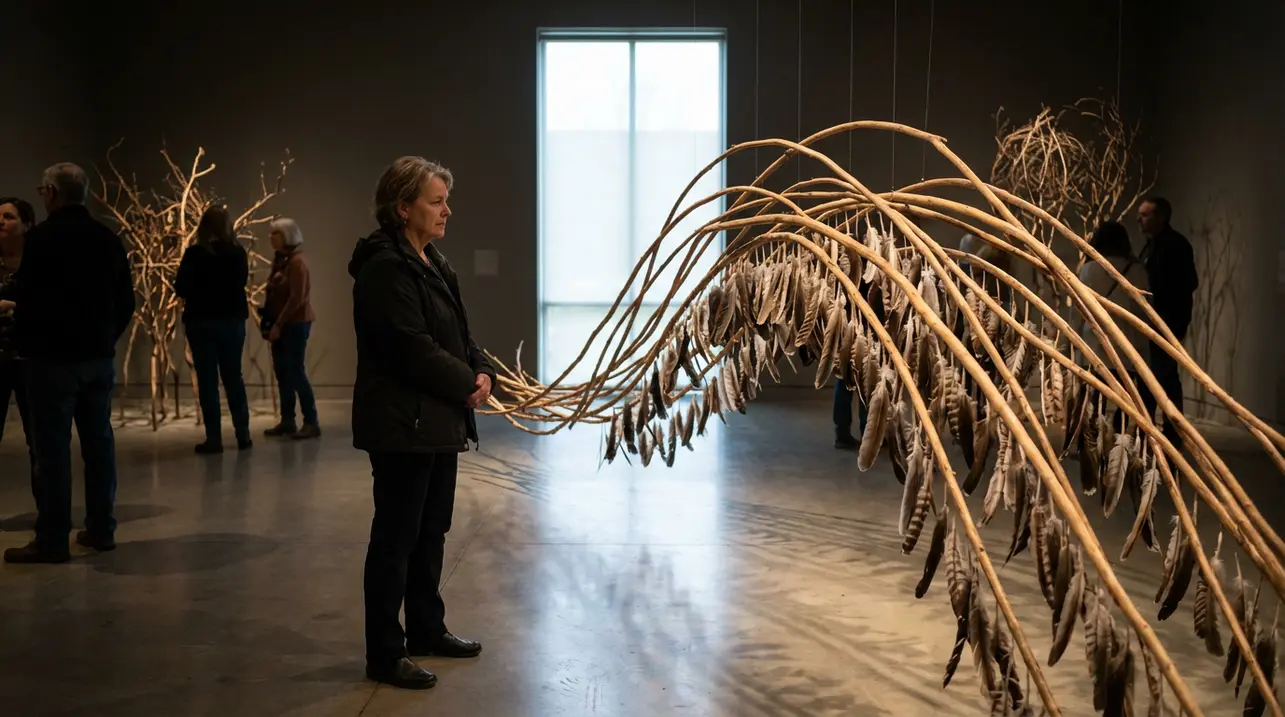
Stepping into the hushed, reverent space of an exhibition dedicated to Truman Lowe feels less like entering a museum gallery and more like wandering into a quiet, sun-dappled stretch of riverbank. The National Museum of the American Indian’s first major retrospective of the acclaimed Hoocąk (Ho-Chunk) artist, titled *Water’s Edge: The Art of Truman Lowe*, is a masterclass in subtle, powerful storytelling through form and material.This isn't a loud, declarative show; it’s a whispered conversation, a collection of nearly 50 sculptures and drawings that hum with the quiet energy of flowing water, bending saplings, and ancestral memory. Lowe, who passed away in 2019, was a quiet giant in the world of contemporary Native art, a professor who shaped generations at the University of Wisconsin-Madison while his own studio practice delved deep into the natural world and its profound cultural resonances.Walking through the exhibition, you’re immediately struck by the materials: slender, peeled saplings of willow and ash, feathers that seem caught in a gentle breeze, raw wood that still carries the scent of the forest. These aren't inert objects placed on pedestals; they are captured moments of transition, poised at that liminal space—the water’s edge—where earth meets river, solidity meets fluidity, and the present tense opens into deep time.A piece like *Winged Migration* isn't just a beautiful arrangement of feathers and wood; it’s a visual poem about movement, diaspora, and the enduring pull of homeland, themes deeply embedded in Ho-Chunk history. His large-scale installations, such as *Red Lake*, use cascading networks of red-tipped saplings to map the very arteries of the land, transforming gallery space into a living, breathing ecosystem.To understand Lowe’s work is to understand a fundamental Ho-Chunk worldview, one intricately tied to the waterways of Wisconsin and Minnesota, a relationship of stewardship and symbiosis that stands in stark contrast to colonial paradigms of resource extraction. Critics and curators have long noted how Lowe’s formal elegance—with its clean lines and minimalist aesthetic—engages in a sophisticated dialogue with modernist sculpture, citing influences from artists like Eva Hesse or Richard Serra.Yet, to stop there is to miss the point entirely. His abstraction is not an embrace of art-for-art’s-sake; it is a deliberate, refined language for expressing Indigenous knowledge systems that are often non-linear and holistic.Dr. Kathleen Ash-Milby, the curator of the exhibition and a member of the Navajo Nation, emphasizes this, noting that Lowe “challenged the boundaries between craft and fine art, between traditional and contemporary, showing that these categories are fluid, much like his beloved rivers.” The retrospective arrives at a critical cultural moment, a time when institutions are grappling with how to present Native art beyond the ethnographic diorama and into the realm of serious contemporary discourse. Lowe’s career itself was a bridge, connecting the studio arts programs of academia with the vibrant, ongoing traditions of Native craft and ceremony.The drawings included in the show are revelations—fluid, calligraphic lines that look like maps of watersheds or the flight patterns of birds, serving as the conceptual blueprints for his three-dimensional work. They reveal an artist thinking through his hands, where the gesture of drawing a line is as connected to the land as the act of bending a willow branch.The consequence of this exhibition extends far beyond the walls of the museum. It offers a new template for appreciation, one that requires slow looking and a willingness to listen to the stories embedded in the material itself.It challenges the art world to expand its canon and to recognize the profound contributions of Native artists not as a separate category, but as central to the story of American art. For visitors, the takeaway is transformative: you leave not just having seen sculptures, but having felt the ripple of water, the resilience of the sapling, and the quiet, unbroken strength of a cultural continuum. Truman Lowe didn’t make art about nature; he made art *from* nature, in conversation with it, reminding us that creativity itself is a natural force, forever flowing, adapting, and enduring at the edge.
#featured
#Truman Lowe
#Ho-Chunk
#Native American art
#sculpture
#retrospective
#National Museum of the American Indian
#Water's Edge
Stay Informed. Act Smarter.
Get weekly highlights, major headlines, and expert insights — then put your knowledge to work in our live prediction markets.
Comments
It's quiet here...Start the conversation by leaving the first comment.