

Entertainmenttheatre & arts
Malaysia's Chingay parade seeks Unesco recognition with Singapore.
NA
Natalie Cooper
5 months ago7 min read
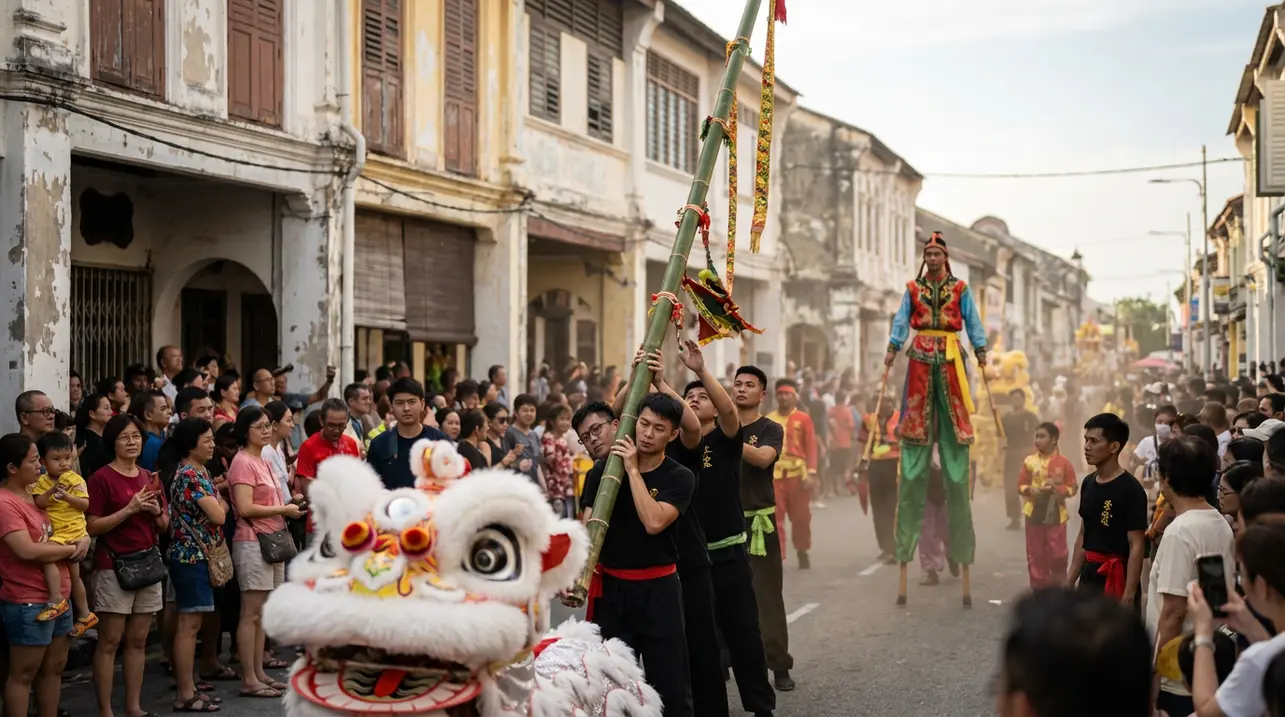
The streets of George Town, a city already humming with the layered history of its own UNESCO World Heritage status, transformed this past Sunday into a living, breathing stage. This wasn't just any performance; it was the annual Chingay parade, a century-old tradition where the air itself seems to hold its breath.Lion dancers pulsed with primal energy, drummers set a heartbeat for the crowd, and stilt walkers towered like gentle giants, but the true stars were those who performed a seemingly impossible act of balance—artists supporting towering, ornate flagpoles, some weighing over 30 kilograms, on nothing but their chins, foreheads, or fingertips. This year, however, the spectacle carried a narrative weight far beyond the physical endurance on display.The vibrant procession in Malaysia, and its counterpart in Singapore, is now at the heart of a joint nomination to UNESCO’s Representative List of the Intangible Cultural Heritage of Humanity. It’s a move that feels less like a simple application and more like the raising of a final, magnificent act in a decades-long cultural production, one where the stakes are the global recognition and preservation of a shared heritage that has, until now, often been celebrated in parallel but separate theaters.The story of Chingay is itself a dramatic saga of migration and adaptation. Its roots trace back to the Chinese communities of Penang in the late 19th century, evolving from religious processions into the competitive, skill-based street performances seen today.The ‘chingay’ itself refers to those breathtakingly tall flagpoles, decorated with vibrant silks and intricate designs, each one a character in a silent, moving opera. In Singapore, the tradition took a different, yet equally compelling, trajectory after being banned in the 1970s, only to be revived as a massive, multi-cultural national parade during Lunar New Year, incorporating Malay, Indian, and other ethnic performances into its fabric.This divergence creates a fascinating duality: the Malaysian iteration often retains a stronger link to its specific Chinese communal and religious origins in Penang and Johor, feeling like an intimate, community-driven pageant, while Singapore’s version has become a state-sponsored spectacle of national identity. Yet, beneath these different productions runs the same script of artistry, resilience, and communal pride.The joint UNESCO bid, therefore, is a powerful act of cultural diplomacy. It acknowledges the common origin while celebrating the distinct evolutions, framing Chingay not as a relic to be museumified, but as a living tradition that breathes and changes with its people.Experts in cultural preservation see this as a strategic masterstroke. Dr.Azeem Khan, a cultural historian specializing in Southeast Asia, notes, 'A unilateral application from either country would have told an incomplete story and could have sparked unnecessary contention over origins. By presenting a united front, Malaysia and Singapore are telling UNESCO, and the world, that cultural heritage can transcend modern political borders.They are showcasing tradition as a connective tissue, not a dividing line. ' The implications of success are profound.UNESCO recognition acts as a powerful spotlight, attracting academic interest, tourism, and crucially, funding for master-apprentice programs to ensure the delicate skills of pole balancing and ornate decoration are passed down. For the aging masters in George Town’s backstreets or Singapore’s community centers, it would be a validation of a lifetime’s dedication.However, the curtain hasn’t closed on this act yet. The UNESCO evaluation process is notoriously rigorous and slow, often taking years.Committees will scrutinize the nomination’s documentation of the tradition’s viability, its community involvement, and the concrete safeguarding measures proposed by both nations. There’s also the inherent tension that comes with any heritage listing: the risk of fossilization.As the tradition gains global fame, there will be pressures to standardize or commercialize the performances, potentially sanding away the local, improvisational nuances that give each parade its soul. The challenge for the ‘Chingay producers’ in both countries will be to harness the UNESCO spotlight not as a static museum display case, but as a dynamic follow-spot that illuminates the tradition’s ongoing evolution, ensuring the next generation of performers can still write their own lines into this magnificent, unfolding street theater.
#Chingay parade
#George Town
#Unesco
#intangible cultural heritage
#Malaysia
#Singapore
#cultural diplomacy
#featured
Stay Informed. Act Smarter.
Get weekly highlights, major headlines, and expert insights — then put your knowledge to work in our live prediction markets.
Comments
It's quiet here...Start the conversation by leaving the first comment.