

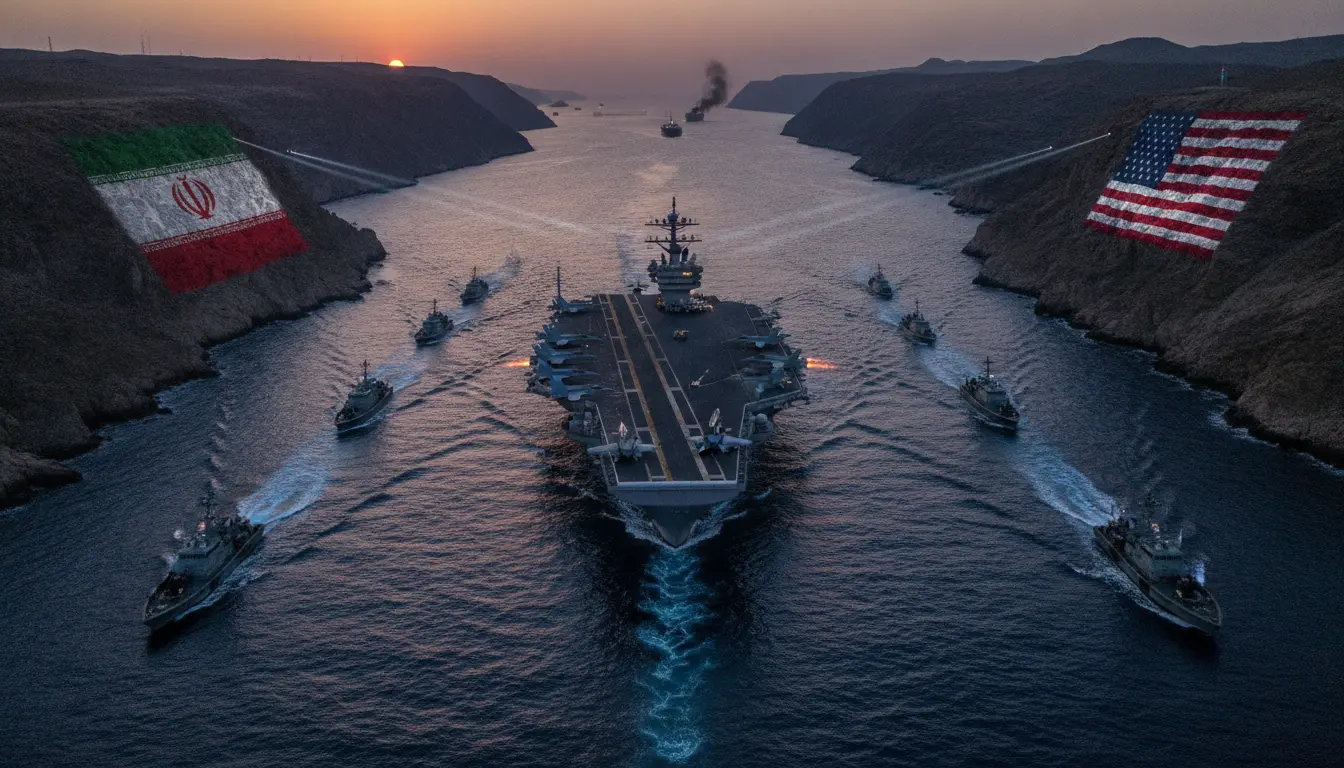
US and Iran Intensify Standoff for Control of Vital Strait of Hormuz
Tensions are escalating dramatically in the Persian Gulf as both the United States and Iran increase their military presence and assert claims of operational control over the Strait of Hormuz. This critical waterway, a global energy choke point through which approximately one-fifth of the world’s oil supply passes daily, has once again become a flashpoint for international concern. The deepening strategic rivalry threatens to disrupt global trade, particularly oil shipments, and carries the ever-present risk of miscalculation leading to a broader regional conflict.
The strategic importance of the Strait of Hormuz cannot be overstated. Connecting the Persian Gulf with the Arabian Sea and beyond, it is bordered by Iran to the north and Oman and the United Arab Emirates to the south. Its narrowest point is just 21 miles wide, with shipping lanes a mere two miles in width, making it highly vulnerable to disruption. For decades, the United States, through its Fifth Fleet based in Bahrain, has maintained a significant naval presence in the region, championing the principle of freedom of navigation and ensuring the safe passage of commercial vessels. This presence is primarily aimed at deterring hostile actions and protecting its allies in the Gulf.
Iran, however, views the Strait differently. From its perspective, the waterway lies within its sphere of influence, and its Revolutionary Guard Corps (IRGC) Navy frequently conducts patrols and drills in the area. Tehran has repeatedly threatened to close the Strait in response to international pressure, particularly economic sanctions, seeing it as a crucial leverage point in its confrontations with the West and its regional adversaries. These threats are often accompanied by actions, such as the harassment or seizure of oil tankers, the deployment of fast-attack boats, and the testing of advanced missile systems, all designed to demonstrate Iran’s capacity to disrupt maritime traffic at will.
Recent months have seen a noticeable intensification of activities from both sides. The U.S. has augmented its naval deployments, including advanced destroyers and, at times, aircraft carrier strike groups, accompanied by strong declarations emphasizing its commitment to regional security and deterrence. These maneuvers are often coordinated with Gulf partners like Saudi Arabia and the UAE, further cementing alliances designed to counter Iranian influence. Concurrently, Iranian forces have stepped up their own military exercises, showcasing new naval capabilities and continuing their policy of intercepting vessels they accuse of violating Iranian waters or international norms, leading to several high-profile incidents involving commercial shipping.
The implications of this escalating standoff are far-reaching. Beyond the immediate danger of military confrontation, any sustained disruption of the Strait of Hormuz would send shockwaves through the global economy. Energy prices would surge, supply chains would be severely impacted, and international trade routes would face unprecedented challenges. Furthermore, the situation complicates diplomatic efforts to de-escalate tensions in the broader Middle East, particularly concerning Iran's nuclear program and its role in regional proxy conflicts. The struggle for de facto control over this narrow stretch of water is not merely a territorial dispute; it is a critical barometer of geopolitical stability and a test of international resolve to maintain open sea lanes.
Analysts warn that the current dynamic is inherently precarious. The close proximity of naval assets from opposing powers, coupled with heightened rhetoric and a history of mutual mistrust, creates fertile ground for accidents or miscalculations to spiral out of control. While neither Washington nor Tehran openly seeks a direct military conflict, the ongoing assertion of sovereign claims and the constant projection of force make incidental engagements a perennial risk. The international community watches closely, understanding that the delicate balance of power in the Strait of Hormuz could define the trajectory of regional stability for years to come.
The strategic contest for the Strait of Hormuz thus represents a complex challenge for global diplomacy and security. It underscores the enduring fragility of peace in a region replete with geopolitical rivalries and economic dependencies. The coming period will likely see continued naval posturing and diplomatic maneuvering, as both the U.S. and Iran seek to solidify their positions without crossing the threshold into open warfare, all while the world’s vital oil supply hangs in the balance.
Stay Informed. Act Smarter.
Get weekly highlights, major headlines, and expert insights — then put your knowledge to work in our live prediction markets.
Related News
Iran says it's closing Strait of Hormuz, citing Israeli strikes on Lebanon
US-Canada Trade War Escalates as Trump Signs Order to Rename Lake Ontario

OpenAI Reportedly Offers U.S. Government 5% Stake Amid Regulatory Pressures

Outpoll Weekly Recap: Finance (August 10 – 16, 2026)

Outpoll Weekly Recap: AI (August 17 – 23, 2026)

Moonshot AI's Kimi K3 Model Challenges US Dominance in Global LLM Race

AI-Driven Tech Rally Faces Growing Scrutiny Amidst Valuation Concerns

OpenAI CEO Sam Altman Plans White House Visit to Shape AI Policy Agenda

PayPal Acquisition Talks Reportedly Intensify with Stripe, Advent International

Outpoll Weekly Recap: AI (August 10 – 16, 2026)