

- News
- Politics
- US-China Tensions Escalate as Beijing Sanctions American Defense Firms in Retaliatory Move
US-China Tensions Escalate as Beijing Sanctions American Defense Firms in Retaliatory Move
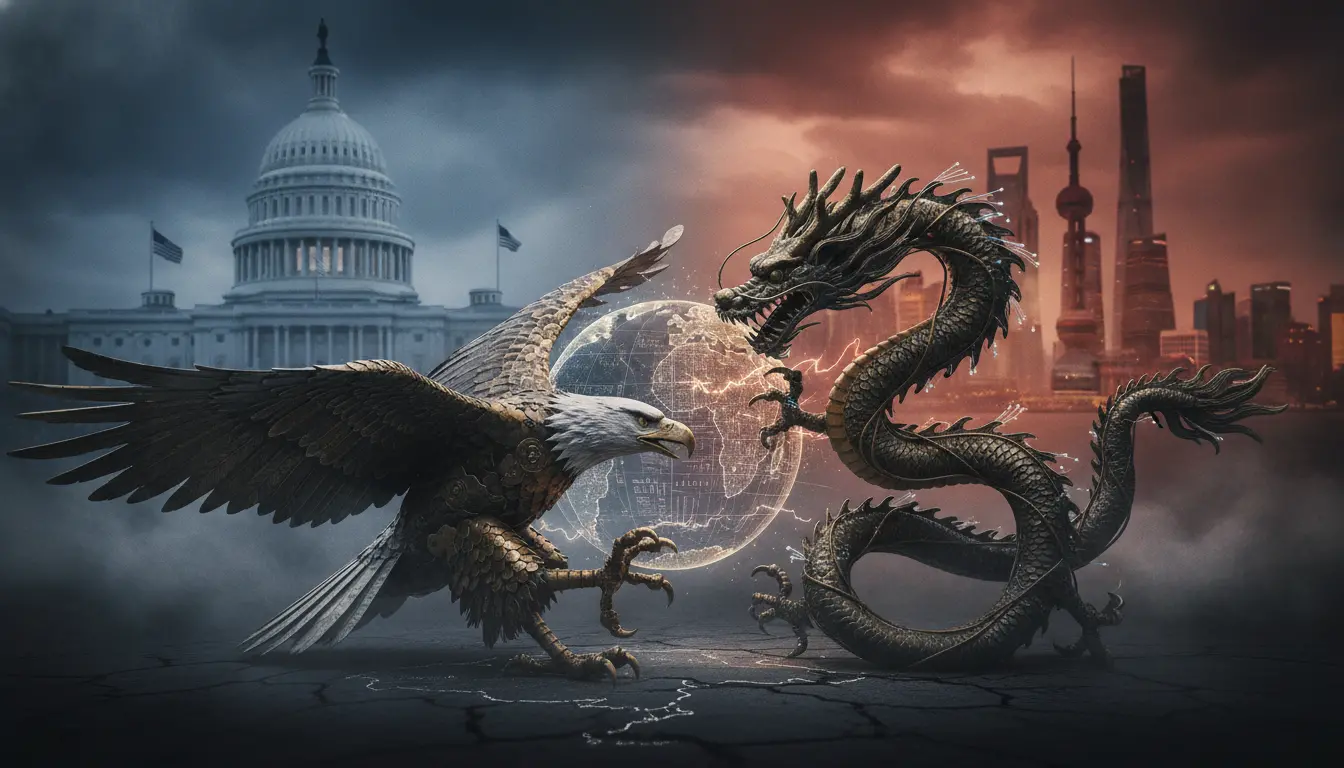
WASHINGTON — The economic rivalry between the United States and China intensified this week as Beijing announced sanctions against a group of American defense and technology companies. The move is a direct retaliation for recent U.S. actions blacklisting several Chinese tech firms, signaling a deepening cycle of reciprocal penalties that continues to destabilize global supply chains and heighten geopolitical friction. China's Ministry of Foreign Affairs named ten U.S. entities, including prominent military contractors, accusing them of involvement in arms sales to Taiwan. This tit-for-tat measure underscores the fragile state of relations between the world’s two largest economies, where high-level diplomatic engagements have yet to produce a lasting de-escalation.
The current standoff is the latest chapter in a protracted economic conflict that began with trade tariffs under the Trump administration and has since evolved into a full-blown strategic competition over technological supremacy. While the Biden administration has moderated the rhetoric on trade, it has doubled down on measures aimed at restricting China's access to critical technologies, particularly advanced semiconductors and the equipment to produce them. Citing national security risks, Washington has leveraged entities lists and export controls to hobble Chinese tech giants like Huawei and SMIC, effectively trying to stall Beijing’s progress in areas from 5G to artificial intelligence. These actions, U.S. officials argue, are necessary to prevent American technology from being used to advance China's military modernization and surveillance capabilities.
From Beijing's perspective, these measures constitute an illegitimate campaign to contain its economic and technological rise. In response, China has developed its own toolkit of countermeasures, including an “unreliable entity list” and an anti-foreign sanctions law. The recent sanctions on U.S. defense firms are a calculated response, targeting an industry of strategic importance to Washington and directly linked to U.S. policy on Taiwan, the most sensitive issue in the bilateral relationship. While the immediate financial impact of these sanctions on sprawling American defense corporations may be limited—as they have minimal direct business in mainland China—the political symbolism is potent. It serves as a clear warning that Beijing is willing and able to impose costs on American interests in response to what it perceives as provocations.
The escalating conflict is creating profound uncertainty for multinational corporations, which are increasingly caught in the crossfire. Companies in sectors ranging from automotive to consumer electronics are being forced to navigate a complex and shifting landscape of regulations from both countries. The “de-risking” strategy, a term favored by Western governments to describe efforts to reduce reliance on Chinese supply chains, is proving difficult and costly to implement. Meanwhile, China is accelerating its own drive for technological self-sufficiency, pouring vast resources into its domestic semiconductor industry and other key sectors to insulate itself from U.S. pressure. This bifurcation of the global tech ecosystem threatens to create two separate, competing spheres of influence, reversing decades of economic integration.
Analysts see no clear off-ramp for the ongoing tensions. Each punitive measure by one side almost invariably invites a countermeasure from the other, creating a self-perpetuating cycle of escalation. The core of the dispute lies in fundamentally different visions for the global order and the role of technology within it. The United States and its allies are focused on preserving a strategic edge and protecting a rules-based system, while China is determined to secure what it views as its rightful place as a global leader, free from external constraints on its technological ambitions. With domestic political pressures in both nations favoring a hardline stance, the prospect of new, more impactful sanctions being announced by either side remains a constant feature of the geopolitical landscape, promising continued volatility for the global economy.
Stay Informed. Act Smarter.
Get weekly highlights, major headlines, and expert insights — then put your knowledge to work in our live prediction markets.
Related News

Anthropic Accuses Alibaba of Systematic Extraction of Claude AI, Setting Stage for High-Stakes IP Showdown

Will Coinbase officially launch tokenized stock trading for U.S. retail investors by October 31, 2026?
OPEC+ Charts Course for Significant Crude Oil Production Expansion by Mid-2026

Warner Bros. Confirms Theatrical Release for Rescued 'Coyote vs. Acme' Film Amidst Industry Scrutiny