

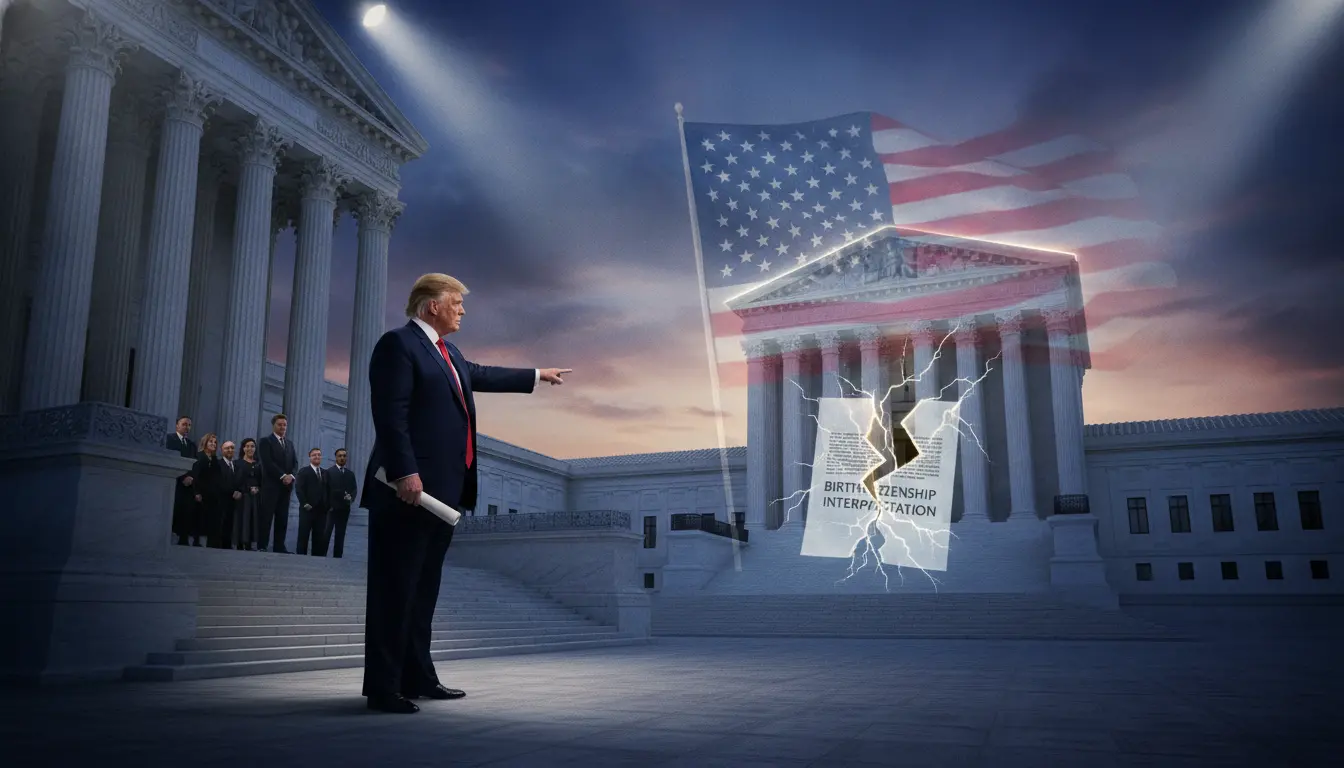
Trump Readies Supreme Court Bid to Overturn Birthright Citizenship Interpretation
Former President Donald Trump is preparing a significant legal challenge to the long-standing interpretation of birthright citizenship, signaling his intent to petition the U.S. Supreme Court. This move, if the Court agrees to hear the case, could trigger a monumental legal battle over a foundational principle of American law and ignite an already volatile national debate on immigration. The potential petition aims to re-examine the scope of the 14th Amendment's Citizenship Clause, a provision that has, for over a century, guaranteed citizenship to nearly all individuals born on U.S. soil.
The heart of the debate lies in the interpretation of the 14th Amendment, ratified in 1868 in the aftermath of the Civil War to grant citizenship to formerly enslaved people. Its first sentence states: “All persons born or naturalized in the United States and subject to the jurisdiction thereof, are citizens of the United States and of the State wherein they reside.” For generations, this clause has been widely understood to confer citizenship on anyone born within U.S. borders, regardless of their parents' immigration status. However, a vocal segment of conservative legal scholars and politicians, including Trump, argue that the phrase "subject to the jurisdiction thereof" was not intended to include children born to parents who are not legal residents, such as undocumented immigrants or temporary visitors. They contend that such individuals are not fully subject to U.S. jurisdiction in the same way citizens or legal permanent residents are.
Trump has long advocated for an end to birthright citizenship, often using it as a key talking point in his campaigns and during his presidency. He has previously explored various avenues, including executive action, to reinterpret or circumvent the existing legal framework, though these efforts faced significant legal hurdles. A direct petition to the Supreme Court represents the most ambitious and potentially impactful strategy to date, aiming to secure a definitive ruling that would alter decades of established legal precedent. The former president's legal team would need to craft an argument compelling enough to persuade at least four justices to grant certiorari, the legal term for agreeing to hear a case.
The Supreme Court, with its current conservative supermajority, has shown a willingness to revisit established precedents in other areas of law. However, granting certiorari on a question as deeply entrenched as birthright citizenship would be an extraordinary step, signaling the Court's readiness to delve into highly contentious constitutional matters with vast societal implications. Legal experts on both sides acknowledge that overturning or significantly reinterpreting the 14th Amendment's citizenship clause would have profound consequences, potentially rendering millions of individuals who were born in the U.S. and currently consider themselves citizens as non-citizens, or creating a new class of individuals with uncertain legal status. Such a shift would not only affect future births but could also create complex retroactive issues.
Opponents of Trump's position, including civil rights organizations and a broad coalition of legal scholars, vehemently argue against any reinterpretation of the 14th Amendment. They point to the plain language of the clause, historical context, and Supreme Court precedent, most notably the 1898 United States v. Wong Kim Ark decision, which affirmed birthright citizenship for the child of Chinese immigrants. These groups contend that altering this fundamental right would be an unprecedented assault on constitutional principles and would create immense instability for families and communities across the nation. They warn of a potential humanitarian crisis and a protracted period of legal uncertainty if the Court were to entertain such a challenge.
The political ramifications of such a Supreme Court engagement would be immense. The issue of birthright citizenship is deeply intertwined with broader immigration debates, national identity, and the upcoming political cycles. A high-profile legal battle at the nation's highest court would undoubtedly galvanize both supporters and opponents, turning the technicalities of constitutional law into a central campaign issue. The outcome, whatever it may be, would reverberate through American society, reshaping legal frameworks, demographic realities, and the very definition of who is an American citizen. The coming months will reveal whether the Supreme Court is prepared to open this new, potentially turbulent, chapter in American jurisprudence.
Ultimately, the path for Trump's challenge is long and uncertain. Even if a petition is filed, the Supreme Court is under no obligation to take the case. The Court considers numerous factors, including the existence of a circuit split (different rulings from different federal appeals courts) or issues of exceptional national importance, before agreeing to hear an appeal. Should the Court decline to review the petition, the prevailing interpretation of birthright citizenship would remain intact, at least through this particular legal avenue. However, the intent to pursue this course underscores the enduring and evolving struggle over core American identity and the legal boundaries of citizenship.
Stay Informed. Act Smarter.
Get weekly highlights, major headlines, and expert insights — then put your knowledge to work in our live prediction markets.
Related News
Supreme Court Poised for Potential Review of Birthright Citizenship Under 14th Amendment

Conservative Coalition Explores Legislative Pathways to Reconsider Birthright Citizenship

Legal Challenges Mount Against Trump Administration's Birthright Citizenship Executive Orders
Advocacy Groups Prepare New Challenges to Supreme Court Asylum Decision
Trump Administration Gains Authority for Potential Deportations as Supreme Court Ends TPS Protections

Deportation Fears Loom for Haitian and Syrian Immigrants as TPS Protections Face Political Headwinds

Project 2025 Blueprints Potential Purge of Independent Agency Heads in a Second Trump Term
Speculation Intensifies Over Donald Trump's 2028 Presidential Bid Ahead of Key 2026 Political Crossroads
Supreme Court Ruling Paves Way for Deportation of Thousands of Haitian and Syrian TPS Holders

Texas Law Mandating Bible Stories in Public Schools Faces Immediate Federal Court Challenge Over Church-State Separation