

Politics
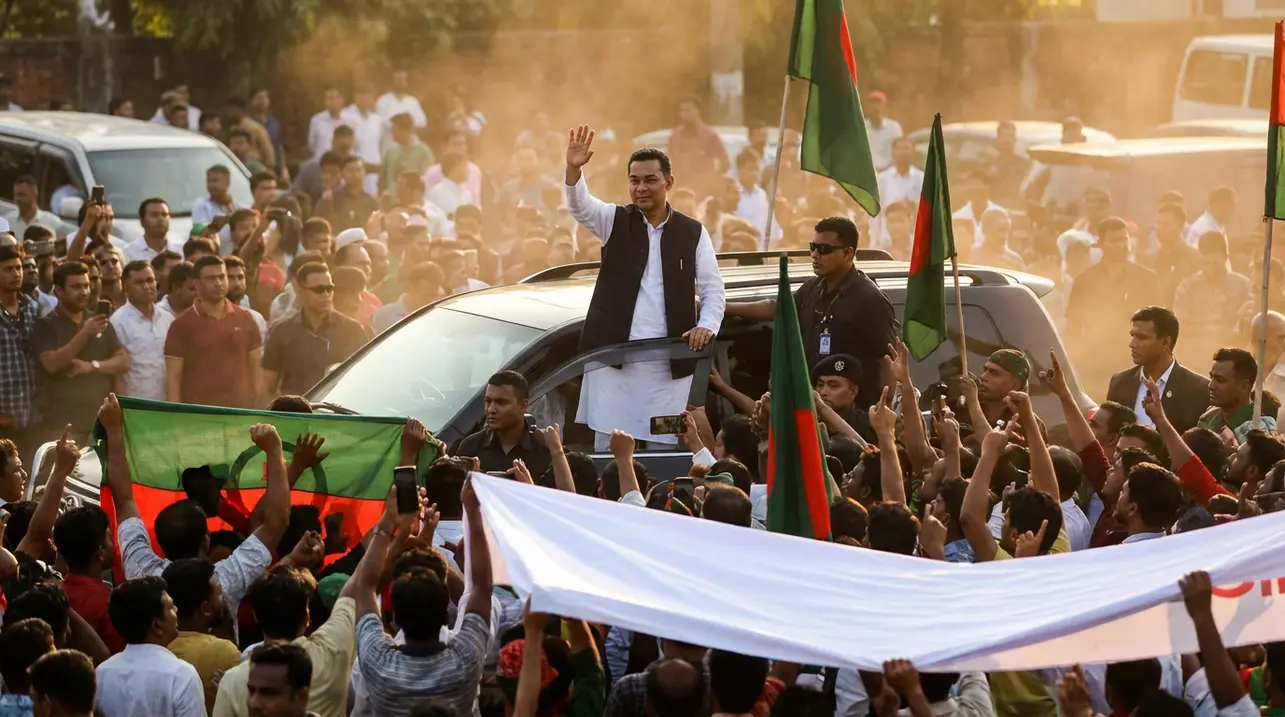
Tarique Rahman returns from exile ahead of Bangladesh elections.
RO
Robert Hayes
6 months ago7 min read
In a development that will send shockwaves through the political landscape of South Asia, Tarique Rahman, the acting chairman of the Bangladesh Nationalist Party (BNP), has returned from a protracted exile in London, touching down in Dhaka mere weeks before a pivotal general election. This is not merely a homecoming; it is a political gambit of the highest order, a move that fundamentally recalibrates the dynamics of a nation perpetually locked in a bitter, dynastic struggle for power.Rahman, the elder son of former Prime Minister Khaleda Zia, has been living in the United Kingdom since 2008, following his release on bail after being imprisoned on charges of corruption and money laundering—allegations he and his supporters have consistently decried as politically motivated fabrications orchestrated by the ruling Awami League. His return, therefore, is a direct challenge to the authority of Prime Minister Sheikh Hasina, whose government has overseen a period of significant economic growth but also one marked by intense allegations of democratic backsliding, electoral manipulation, and the systematic suppression of opposition voices.The historical parallels are stark and unsettling; one is reminded of the turbulent transitions of power in the 1990s and early 2000s, where the nation oscillated between the two powerful women and their legacies, a cycle of recrimination that Rahman’s exile had temporarily paused. His presence on the ground transforms the BNP from a party led from afar, often through digital manifestos and proxy speeches, into one with its standard-bearer physically in the fray, capable of mobilizing the party's grassroots base in a way that virtual leadership never could.Analysts are already dissecting the potential consequences: will his return galvanize a fragmented opposition into a coherent electoral force, or will it provide the government with a focal point for renewed legal and political pressure? The specter of violence looms large, given the BNP's planned boycott of the 2014 election and the deadly clashes that marred the 2018 polls. Furthermore, the international community, particularly observers from Washington, Brussels, and the United Nations, will be watching with heightened scrutiny, as Bangladesh's strategic importance as a economic powerhouse and a counterweight to Chinese influence in the Bay of Bengal makes its political stability a matter of global concern.Rahman’s narrative—that of the exiled heir returning to reclaim his political birthright—is powerful, but it is countered by the government's narrative of a convicted criminal evading justice. This sets the stage for an election that is less about policy platforms on infrastructure or climate resilience, and more a raw, existential battle for legitimacy and survival between two deeply entrenched political dynasties. The coming weeks will reveal whether Rahman’s calculated risk reignites a democratic contest or accelerates the nation's drift toward a de facto one-party state, a outcome with profound implications for the 170 million people of Bangladesh and for the delicate democratic fabric of the region.
#Bangladesh
#Tarique Rahman
#elections
#exile
#London
#politics
#featured
Stay Informed. Act Smarter.
Get weekly highlights, major headlines, and expert insights — then put your knowledge to work in our live prediction markets.
Related News

Comments
It's quiet here...Start the conversation by leaving the first comment.