


G7 Leadership Turmoil Deepens as Starmer Exit Fuels Speculation on Succession Waves
The political landscape of the Group of Seven leading industrial democracies has been thrown into renewed uncertainty following the resignation of British Prime Minister Keir Starmer. While Starmer’s departure marks a significant shift in UK politics, the event has also intensified scrutiny on the stability of other G7 heads of government, with analysts questioning whether a broader wave of leadership changes could reshape the alliance before the end of 2026. The question now is not merely who will succeed Starmer, but whether other sitting G7 leaders can withstand mounting domestic pressures that have already claimed one of their own.
Starmer’s resignation, announced after a period of declining approval ratings and internal party strife, has sent shockwaves through diplomatic circles. His exit underscores a broader trend of political fragility across the G7, where leaders in several member nations are grappling with economic stagnation, immigration crises, and deep societal divisions. In France, President Emmanuel Macron faces a restive parliament and persistent protests over pension reforms, while German Chancellor Olaf Scholz’s coalition government is fraying amid disputes over energy policy and fiscal discipline. Canadian Prime Minister Justin Trudeau, once a dominant figure, now trails in opinion polls as housing affordability and cost-of-living issues erode his support. Italian Prime Minister Giorgia Meloni, though more stable, navigates a coalition with eurosceptic partners that could fracture over EU budget rules. Japanese Prime Minister Fumio Kishida is battling a funding scandal and public discontent, and U.S. President Joe Biden, at 81, faces questions about his age and electoral viability ahead of the 2024 presidential race.
The confluence of these pressures has led political risk analysts to warn that the G7 could see an unusually high turnover of leaders within the next two years. Historically, leadership changes in major economies have been staggered, but the current cycle is marked by synchronized challenges: post-pandemic inflation, the energy shock from the war in Ukraine, and the rise of populist movements that punish incumbents. “We are witnessing a moment of democratic turbulence where the traditional bulwarks of stability—incumbency, party discipline, and economic growth—are all under strain,” said Dr. Helena Richter, a professor of comparative politics at the London School of Economics. “The G7 leaders are not immune; in fact, they are on the front lines.”
Beyond domestic woes, the geopolitical stakes are high. A rapid succession of leadership changes could disrupt the G7’s collective response to major global challenges, including continued support for Ukraine, climate change commitments, and managing competition with China. Starmer’s departure, for instance, comes at a critical juncture for UK-EU relations, as London seeks to reset ties after Brexit. A new British prime minister might adopt a different stance on trade or security, potentially altering the bloc’s cohesion. Similarly, if Scholz were to fall, Germany’s role as Europe’s economic engine could shift, with implications for EU fiscal policy and NATO defense spending targets.
In Washington, President Biden’s potential departure—whether through electoral defeat or health-related reasons—would be the most consequential. The 2024 U.S. election is already shaping up to be a referendum on Biden’s leadership, with former President Donald Trump leading in some polls. A Trump return would fundamentally alter G7 dynamics, given his previous skepticism of multilateral alliances and trade agreements. Even if Biden remains, his ability to project strength abroad is hampered by domestic political battles, including a looming government shutdown and investigations by House Republicans.
The uncertainty is not lost on financial markets. Investors are closely watching political developments in G7 capitals, as leadership instability often leads to policy paralysis or abrupt reversals. Currency markets have already shown volatility in response to Starmer’s resignation, with the pound dipping slightly before recovering. Bond yields in Italy and France have edged higher, reflecting concerns about fiscal discipline if governments become distracted by succession battles. “Markets hate uncertainty, and the G7 is currently a cauldron of it,” said Marcus Chen, a senior geopolitical strategist at a London-based investment firm. “Every resignation or close election adds a risk premium to that country’s assets.”
Looking ahead, the next 18 months will be a test of the G7’s resilience. While some leaders may cling to power through deft coalition management or economic upturns, the structural forces at play suggest that more departures are likely. The question is not whether any other current G7 leader will leave office before the end of 2026—it is how many, and what that will mean for the liberal international order that the G7 has long championed. For now, the world watches as the dominoes begin to fall.
Stay Informed. Act Smarter.
Get weekly highlights, major headlines, and expert insights — then put your knowledge to work in our live prediction markets.
Related News

Political Headwinds Batter G7 Leaders, Threatening Major Shakeup by 2026
G7 Leaders Face Intensifying Political Pressures, Raising Questions About Tenure Through 2026

G7 Nations Face Intensifying Scrutiny Over Leadership Stability Amid Domestic and Global Pressures
Political Turmoil and Electoral Pressures Challenge G7 Leaders Ahead of 2026
G7 Leaders Grapple with Widespread Political Volatility and Looming Electoral Challenges
G7 Leaders Face Heightened Scrutiny Amid Turbulent Political Landscape Through 2026

G7 Nations Face Heightened Prospects of Leadership Changes by End of 2026
G7 Leaders Face Intensifying Political Pressures and Electoral Challenges Through 2026
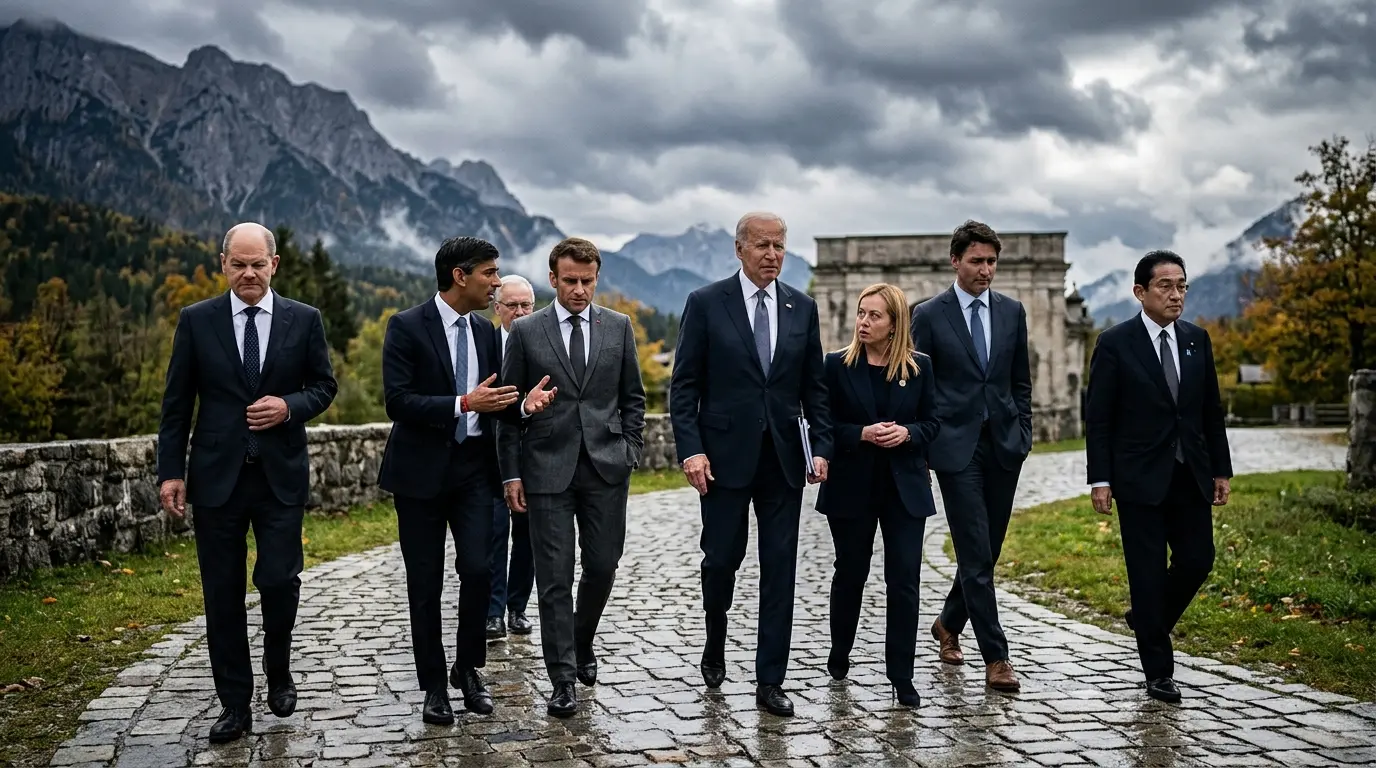
G7 Leaders Navigate Tumultuous Political Landscape Amidst Domestic Pressures and Upcoming Elections
G7 Leaders Navigate Tumultuous Political Landscape Ahead of Key Electoral Tests