OthereducationSchool Reforms
Chinese student seeks bottle donations for mother's medical bills
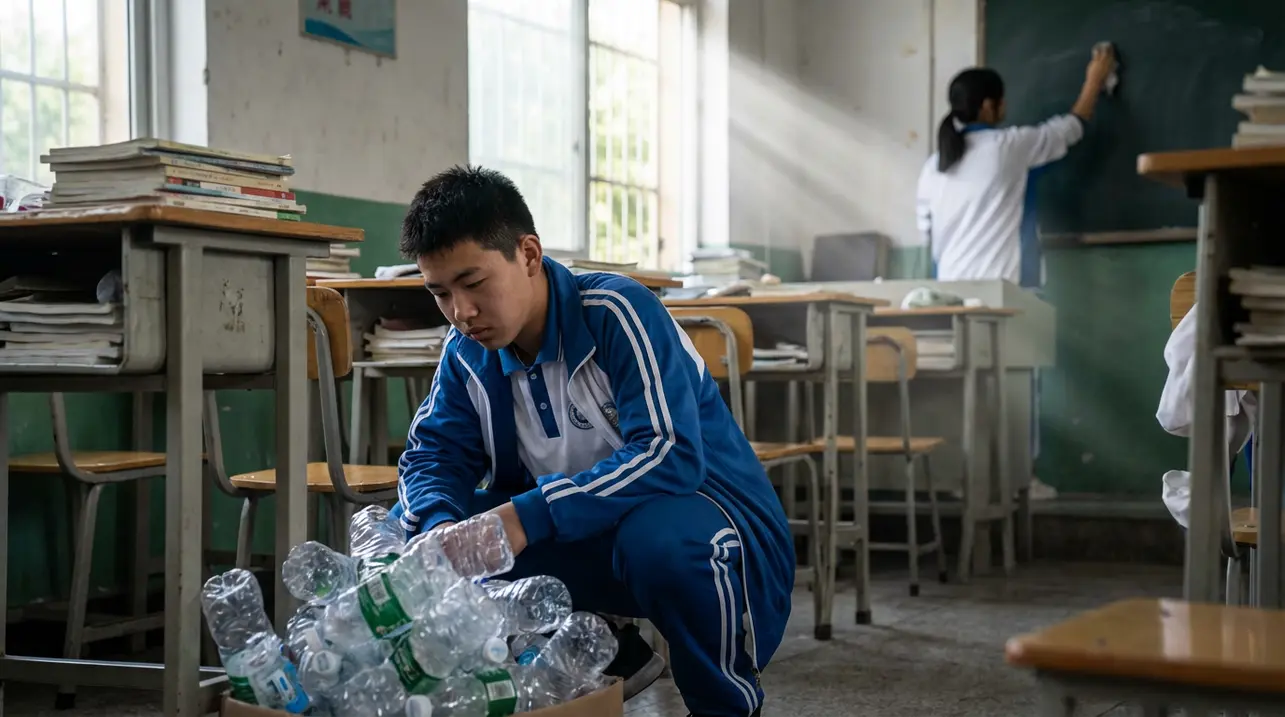
In the quiet hum of a classroom at No 5 Middle School in Huainan, a city in China's eastern Anhui province, a simple message appeared on the blackboard, written not by a teacher but by a Grade Two pupil. It was a plea, stripped of any pretension, asking his classmates to save their used water bottles so he could sell them.The reason was heartbreakingly direct: to help ease his family’s financial burden, specifically his mother's mounting medical bills. This wasn't a viral campaign launched by an NGO or a corporate social responsibility initiative; it was the raw, unfiltered action of a child stepping into an adult world of worry far too soon.By the end of November, the image of that blackboard note, shared online by his peers, had rippled across Chinese social media, sparking an outpouring of praise, empathy, and a complex conversation about the social safety nets that catch—or fail to catch—families in freefall. The story cuts to the core of a universal human experience: the moment a child becomes acutely aware of their family's fragility.We often hear about medical debt crippling households, but we see it through statistics or policy debates. Here, it was manifested in the tangible, humble form of a plastic bottle, a symbol of both environmental concern and, in this context, desperate economic calculation.The pupil’s initiative speaks to a profound sense of filial piety, a cornerstone of Chinese culture, yet it also highlights the immense pressure placed on individuals, even children, when systemic support is insufficient. While China has made significant strides in expanding healthcare coverage, gaps remain, particularly for serious or chronic illnesses where out-of-pocket expenses can still be catastrophic.This boy’s story is not an isolated incident but a poignant data point in a broader narrative about healthcare affordability and the hidden struggles within communities. The online reaction—largely one of admiration for his maturity and responsibility—also carries an unspoken critique.Why must a secondary school student feel compelled to become a micro-entrepreneur in recyclables to contribute to his mother's wellbeing? The narrative invites us to look beyond the inspiring individual act to the societal architecture that allowed this situation to arise. It echoes stories from around the world where children take on paper routes, odd jobs, or crowdfunding campaigns to support ailing parents, each story a testament to resilience but also a marker of systemic strain.Furthermore, the mechanism of his appeal—the classroom blackboard—is powerfully analog in a digital age. It wasn't a GoFundMe page with a professionally shot video; it was a local, community-based request, leveraging the immediate social network of his school.
#human interest
#charity
#education
#social media
#family health
#featured