OthereducationEdTech Innovations
Apple-backed classroom brings top-notch education to rural Alabama.
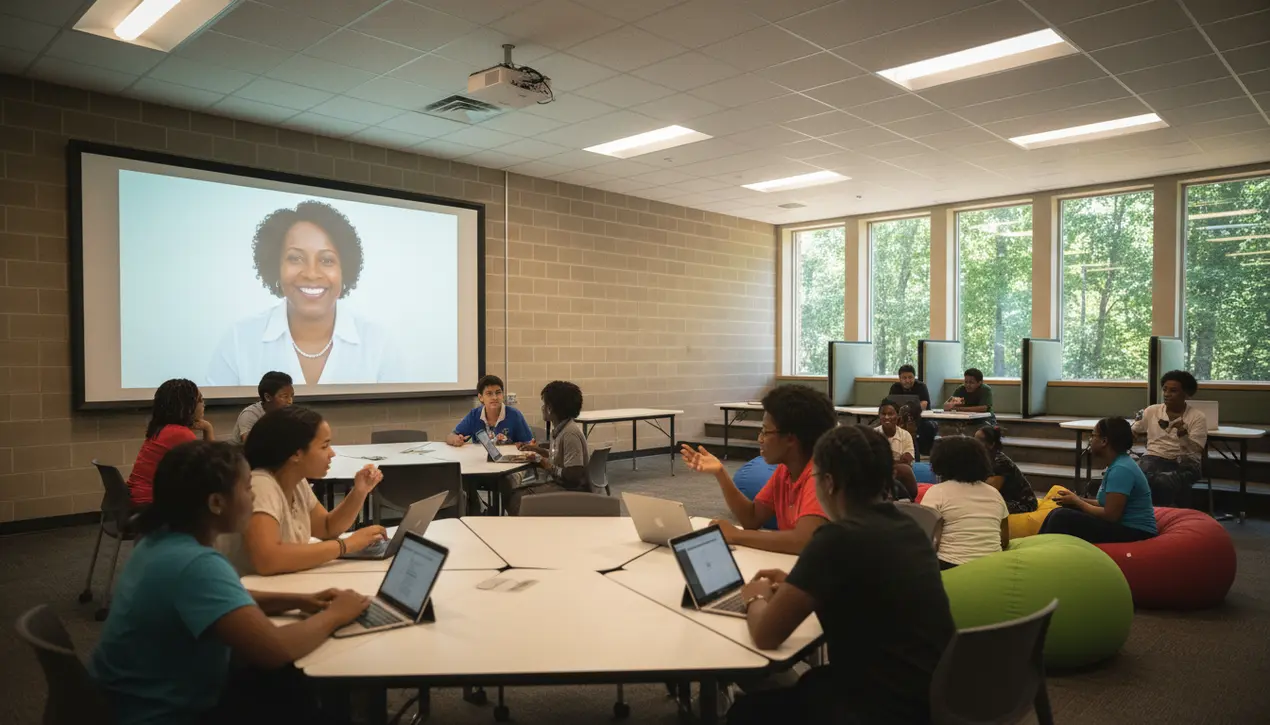
In the heart of rural Uniontown, Alabama, a quiet revolution is unfolding within the cinderblock walls of Robert C. Hatch High School.The 'Introduction to Innovation' class begins not with a teacher standing at a chalkboard, but with one beaming in from a distant city, their face filling a wall-sized screen. This is the Connected Rural Classroom, a prototype designed by the architecture firm Kurani and supported by the Birmingham-based nonprofit Ed Farm, with foundational backing from Apple and the Alabama Power Foundation.It represents a profound re-imagining of educational equity, specifically targeting the chronic shortage of high-quality STEM teachers in underserved communities. Waymond Jackson, president of Ed Farm, articulates the core problem with the clarity of a biologist diagnosing an ecosystem under stress: 'Especially in Alabama, there’s just a lack of high-quality STEM teachers and math teachers that those students in rural areas have access to.' This initiative is a direct, technologically sophisticated intervention into that environment. The classroom itself is the antithesis of the traditional, linoleum-floored box with rigid desks.It more closely resembles a cutting-edge tech startup's collaborative space, featuring movable tables, standing desks, rocking chairs, ottomans, and even stadium seating along the back wall. A line of focus booths offers students a view of the trees outside, a deliberate nod to the biophilic design principle that connection to nature enhances cognitive function.The design is deeply intentional, from the sound-absorptive materials that tame the acoustic chaos of teenagers to the circadian-rhythm-optimized lighting that mimics daylight, compensating for the room's single wall of windows. This is not merely aesthetic; it is environmental engineering for learning.Founder Danish Kurani explains that a primary challenge was designing for the remote instructor's experience, creating a sense of presence and connection across the digital divide. 'We went to great lengths to essentially try to make it easier for the remote instructor,' Kurani says.'It’s far more difficult when you’re remote, especially when you’re dealing with high school students. Like, how do you have presence in the room? How do you connect with them?' The solution is an embedded network of cameras and technology that allows the remote teacher to beam to specific screens for small-group work or directly onto a student’s tablet for one-on-one instruction, creating a fluid, dynamic learning environment.The project's roots trace back to Ed Farm's launch in February 2020, an initiative Apple CEO Tim Cook, an Alabama native, championed at its inception. Cook’s statement that 'Ed Farm is about clearing a path for anyone—of any age, background, or interest' underscores a philosophy of inclusive growth.This classroom is the physical manifestation of that ethos. Jackson sees a fundamental 'misalignment between today’s workforce, today’s classroom, and tomorrow’s workforce,' a disconnect as stark as the one between industrial pollution and a healthy forest.The design's scalability was paramount. Kurani’s team researched average American public school classrooms—typically 700 to 900 square feet with a door in one corner and a single wall of windows—and created a 'kit of parts' prototype that can be adapted to fit this common footprint almost anywhere.This is crucial, as the ambition is to plant these seeds of opportunity beyond Alabama's Black Belt. 'This is truly a model that can be scaled state by state,' Jackson asserts, envisioning a future where unused community assets everywhere are transformed into hubs of technological literacy.The project’s significance extends beyond its immediate educational impact. It is a case study in systemic change, demonstrating how cross-sector collaboration—nonprofits, corporate partners, state government, and innovative architects—can address deeply entrenched inequities.In an era of escalating climate crises and technological disruption, fostering scientific and digital fluency in every community, not just affluent urban centers, is as vital as preserving biodiversity. The Connected Rural Classroom is more than a high-tech Zoom setup; it is an ecosystem restoration project for the American educational landscape, carefully designed to help the most vulnerable students not just survive, but thrive.
#Connected Rural Classroom
#STEM Education
#Remote Learning
#Ed Farm
#Apple
#Alabama
#featured