

OthereducationEducational Policy
Accessibility Should Be at the Center of Museum Education
AN
Anna Wright
5 months ago7 min read
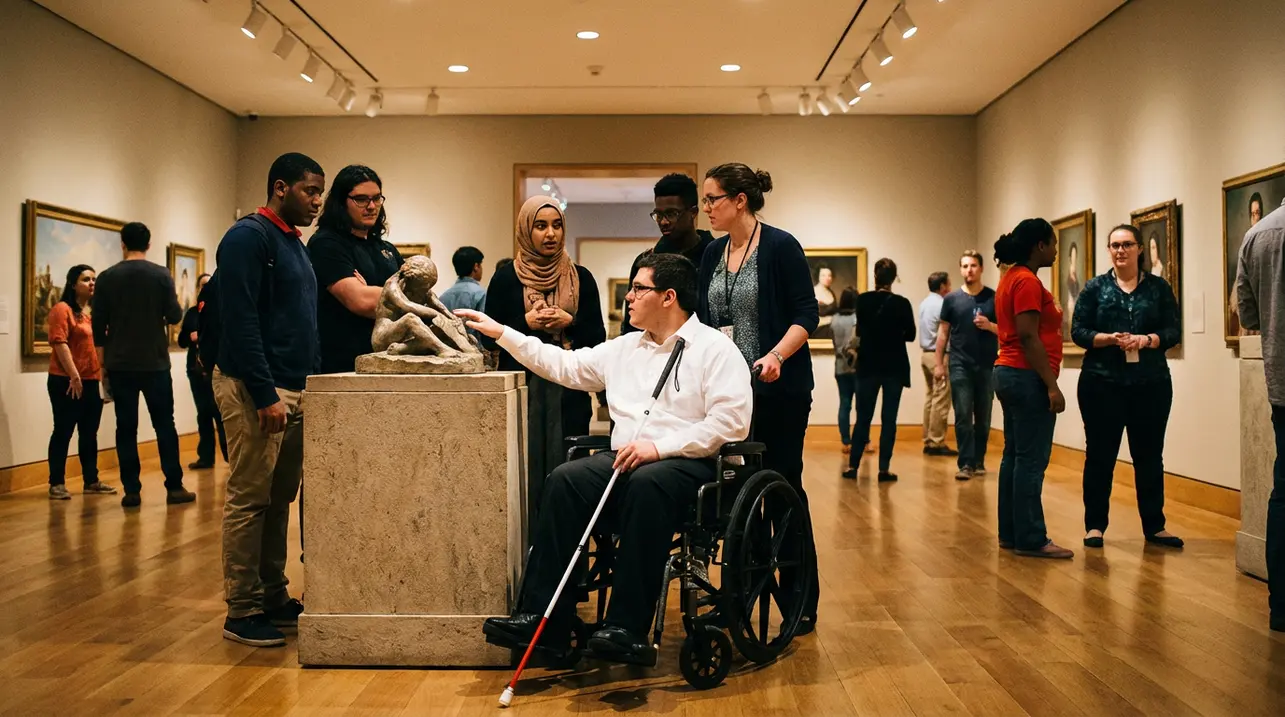
The conversation around art, politics, and identity has never been more urgent, yet a critical perspective remains conspicuously absent from the core of art history education. While departments meticulously deconstruct gender, race, and class, the study of disability—a fundamental facet of the human experience and a powerful lens for understanding representation, access, and power—is too often relegated to a single elective or ignored entirely.This isn't just an academic oversight; it's a failure of imagination that ripples out into our cultural institutions. When future curators, critics, and educators aren't taught to see disability as a cultural and political identity, rather than just a medical condition, they perpetuate museums as spaces of exclusion.The result? Collections remain interpreted through an abled-bodied default, physical and sensory barriers persist as afterthoughts, and the rich, disruptive history of disability in art goes untold. True accessibility isn't a ramp added to the side of a building; it's a foundational principle that must be woven into the very fabric of how we teach art history.It demands we ask who gets to be an artist, whose body is deemed worthy of representation, and who feels welcome in the gallery. Until disability studies is embedded in the curriculum, not as a niche topic but as central to understanding aesthetics and society, museums will continue to preach inclusion while practicing a subtle, institutional ableism that silences a vast spectrum of human creativity and experience.
#disability studies
#museum education
#accessibility
#art history
#curriculum
#inclusion
#editorial picks news
Stay Informed. Act Smarter.
Get weekly highlights, major headlines, and expert insights — then put your knowledge to work in our live prediction markets.
Related News






1 month ago
Outpoll Weekly Recap: Other (April 20 – 26, 2026)

2 months ago
Outpoll Weekly Recap: Other (April 13 – 19, 2026)

2 months ago
Why ‘others have it harder’ is a form of empathy bypassing

2 months ago
Outpoll Weekly Recap: Other (March 30 – April 5, 2026)

2 months ago
Outpoll Weekly Recap: Other (March 23 – 29, 2026)

3 months ago
Outpoll Weekly Recap: Other (March 16 – 22, 2026)
3 months ago
Washington State Passes Millionaires Tax as Model for Others

3 months ago
Outpoll Weekly Recap: Other (March 9 – 15, 2026)

3 months ago
Telura Emerges with €4M Seed to De-Risk Deep Geothermal, as Europe's Subsurface Energy Race Intensifies

3 months ago
Outpoll Weekly Recap: Other (March 2 – 8, 2026)
Comments
It's quiet here...Start the conversation by leaving the first comment.