

- News
- Finance
- Tech Giants' AI Spending Spree Nears Trillion-Dollar Mark as Infrastructure Race Intensifies
Tech Giants' AI Spending Spree Nears Trillion-Dollar Mark as Infrastructure Race Intensifies
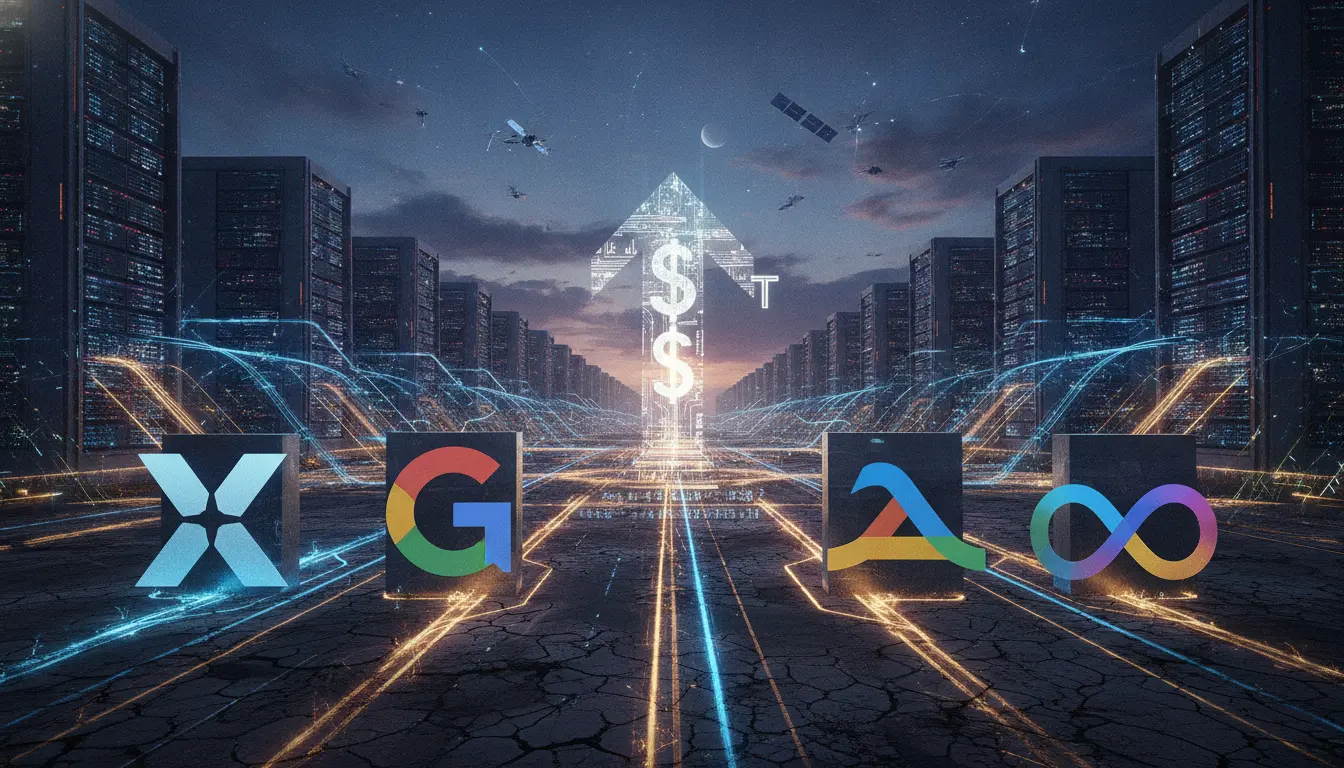
A tectonic shift is underway in Silicon Valley, where an unprecedented capital expenditure arms race is escalating among the world’s largest technology companies. Microsoft, Alphabet, Amazon, and Meta are collectively pouring hundreds of billions of dollars into building the foundational infrastructure for artificial intelligence, a spending blitz poised to redefine the digital economy. This wave of investment, focused on securing vast fleets of specialized computer chips and constructing hyper-scale data centers, signals a new era where computational power, not just software, is the ultimate currency of dominance. Analysts project the combined AI-related capital outlay from these four giants could approach a staggering $800 billion by the end of 2026, a figure that underscores the high-stakes battle for control over the next generation of technology.
The catalyst for this spending frenzy was the public arrival of sophisticated generative AI models, which demonstrated a voracious appetite for processing power. To train and operate these complex systems, which can generate human-like text, images, and code, companies require immense computational resources far beyond traditional server farms. The core of this infrastructure is the Graphics Processing Unit (GPU), a market overwhelmingly dominated by Nvidia Corp. The soaring demand has turned Nvidia into a kingmaker, with its valuation rocketing past those of its own clients as they scramble to secure its highly sought-after chips. This has created a significant bottleneck, prompting the tech titans to not only buy every GPU they can but also to invest heavily in developing their own custom AI silicon to mitigate supply chain risks and control their technological destinies.
Each of the four hyperscalers is pursuing a distinct yet equally ambitious strategy. Microsoft, through its deep partnership with OpenAI, has committed billions to building out its Azure cloud platform with cutting-edge supercomputers designed to handle massive AI workloads. Alphabet, Google’s parent company, is leveraging its long-standing AI research prowess by scaling up production of its homegrown Tensor Processing Units (TPUs) while aggressively integrating its Gemini models across its vast ecosystem of products, from Search to Cloud. Amazon Web Services (AWS), the long-time leader in cloud computing, is defending its turf by developing its own Trainium and Inferentia chips, offering customers an alternative to costly Nvidia hardware. Meanwhile, Meta Platforms has pivoted dramatically, with CEO Mark Zuckerberg declaring a mission to build Artificial General Intelligence (AGI) and committing to acquiring hundreds of thousands of high-end GPUs to power its open-source Llama models and future metaverse applications.
The economic ripple effects of this infrastructure build-out are immense. The spending is a massive tailwind for the entire semiconductor supply chain, from chip designers like Nvidia and AMD to manufacturers like TSMC. However, it also erects formidable barriers to entry. The sheer scale of capital required to compete at the foundational model level is now so vast that it effectively cements the dominance of a handful of well-capitalized players, leaving startups and smaller competitors to build applications on top of the giants' platforms. This concentration of power is raising concerns among regulators and ethicists, who worry about the implications of having the future of AI controlled by a small oligopoly.
Looking ahead, the AI infrastructure race shows no signs of slowing. The investments being made today are not merely for current-generation models but are a down payment on a future where AI is deeply embedded in every facet of business and daily life. The outcome of this contest will determine which companies command the critical platforms of the 21st century. Yet, the path is fraught with risk. The staggering costs are a drag on short-term profitability, and there remains the question of whether the eventual revenue generated by AI services will justify the colossal upfront investment. Furthermore, the immense energy consumption of these AI data centers poses a significant environmental challenge, adding another layer of complexity to this transformative, and monumentally expensive, technological revolution.
Stay Informed. Act Smarter.
Get weekly highlights, major headlines, and expert insights — then put your knowledge to work in our live prediction markets.
Related News

AI Chip Demand Fuels Sky-High Expectations for Nvidia's Data Center Revenue Ahead of Q2 Fiscal 2027 Earnings

Nvidia Q2 FY2027 Earnings Report to Spotlight Data Center Segment Amid Exploding AI Demand

South Korea Poised for Trillion-Dollar Investment in AI and Semiconductor Industries

Top AI Labs Eye 2026 for Potential Artificial General Intelligence Breakthrough Claim

AMD Set to Unveil MI450X/MI550X AI Accelerator Roadmap and Major Customer Wins at Q2 2026 Earnings

Data Center Operator Csquare Targets July 2026 IPO with $3.9 Billion Valuation

FTC Intensifies Antitrust Scrutiny on Major Tech Companies

Apple's Services Segment Under Intense Scrutiny Ahead of Q3 2026 Earnings

Nintendo Confirms Switch Successor in Development as Industry Awaits Details on Next-Gen Hardware

Netflix, Focus Pass on Luca Guadagnino’s ‘Artificial’ After Amazon MGM Studios Dropped Sam Altman-OpenAI Movie