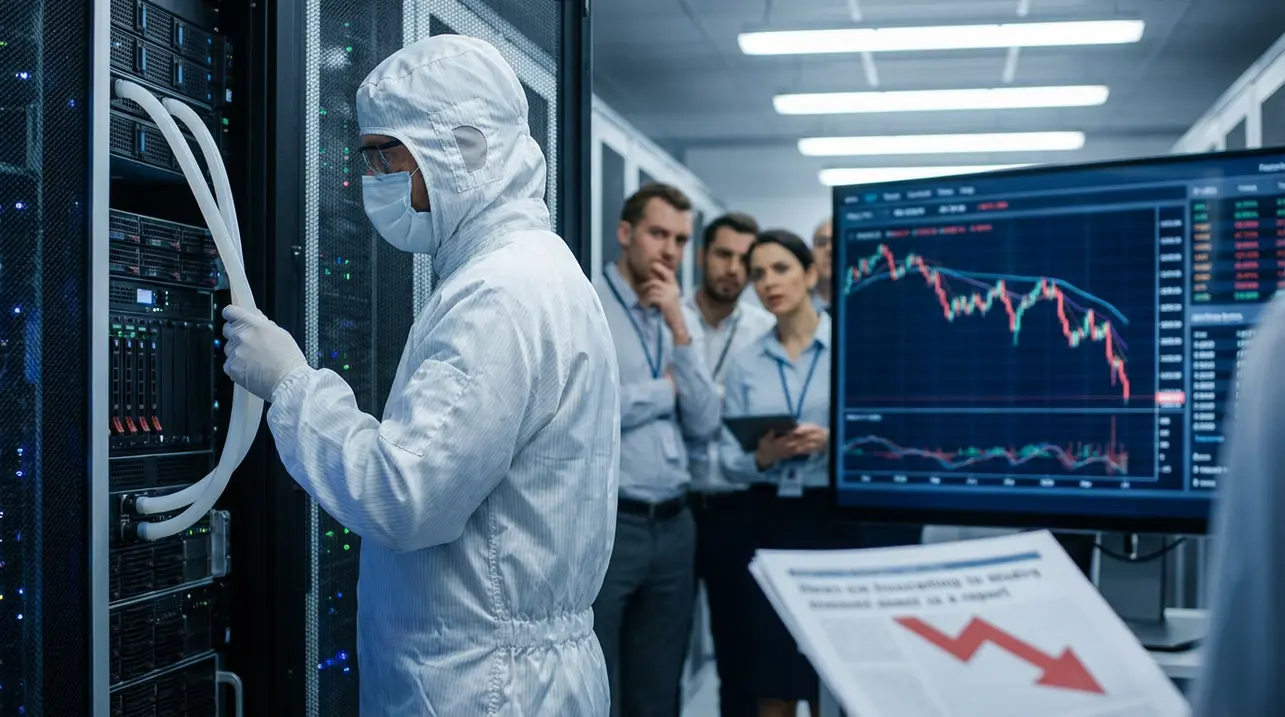
Nvidia's new chips tank cooling system stocks after CES comments.
The stock market is a fickle beast, and nothing proves that quite like the immediate, chilling effect a few words from a tech titan can have on an entire industrial sector. This week, that titan was Nvidia CEO Jensen Huang, and his target, albeit unintentionally, was the once-hot market for data center cooling systems.Speaking at the Consumer Electronics Show in Las Vegas, Huang unveiled the company's next-generation Rubin AI platform, touting its 'extreme codesign' that integrates chips, trays, and racks into a 100% liquid-cooled system he called a 'breakthrough. ' For investors, the subtext was as clear as a bell: the future of AI compute might not rely on the traditional chiller-based cooling infrastructure that has been a cornerstone of data center design.The reaction was swift and brutal. Shares of Modine Manufacturing Co., a key player in thermal management, plummeted as much as 21% in intraday trading before paring losses to close down 7. 5%.The sell-off contagion spread to blue-chip giants like Johnson Controls, Trane Technologies, and Carrier Global, each shedding up to 6. 2%.Even connector and cable specialist Amphenol got caught in the downdraft, briefly falling over 6% on fears its components might be rendered obsolete by Nvidia's more integrated approach, before staging a partial recovery. This episode is a masterclass in market sentiment and forward-looking valuation.For months, cooling system manufacturers have been riding a wave of unprecedented demand, fueled by the explosive growth of power-hungry AI data centers. Analysts had been upgrading price targets and touting multi-year growth runways.Huang's comments, however, introduced a powerful element of long-term technological risk. As Baird analyst Timothy Wojs noted, the remarks 'create some questions/concerns about the longer-term positioning of chillers within data centers over time, particularly as liquid cooling becomes more prominent.' Liquid cooling is more efficient at handling the intense thermal loads of advanced AI chips, operating at higher temperatures and potentially reducing both capital expenditure and operational energy costs—a critical factor as power availability becomes a bottleneck for AI expansion. The historical parallel here is instructive.Think of the shift from traditional internal combustion engines to electric vehicles and its impact on the complex ecosystem of manufacturers producing exhaust systems, fuel injectors, and radiators. A technological pivot at the core ripples out, creating winners and losers across the supply chain.Nvidia's move suggests a desire to control more of its stack, optimizing performance and efficiency but simultaneously disintermediating incumbent suppliers. It's a reminder that in the high-stakes race for AI supremacy, even ancillary industries are subject to violent re-rating based on the strategic roadmaps of a handful of dominant players like Nvidia, AMD, and Intel.Furthermore, the market's knee-jerk reaction may be overblown but is analytically significant. The transition to widespread liquid cooling won't happen overnight; the global installed base of air-cooled data centers is colossal, and retrofits will take years, if not decades.Companies like Vertiv and Schneider Electric, which offer broader infrastructure solutions, may be better insulated. Yet, the signal is clear: the era of assuming perpetual growth for any single component of the AI hardware stack is over.Investors must now scrutinize technological moats and adaptability. The fact that Nvidia's own stock dipped slightly even as the S&P 500 hit a record high underscores the complex dynamics—the company is driving the future but also sowing uncertainty in the very ecosystem it relies upon. In the end, this isn't just a story about cooling stocks tanking; it's a case study in how a single keynote can recalibrate Wall Street's perception of an industry's terminal value, forcing a painful but necessary reassessment of risk in the white-hot AI trade.
#Nvidia
#data center cooling
#CES
#stock market reaction
#chip innovation
#featured