

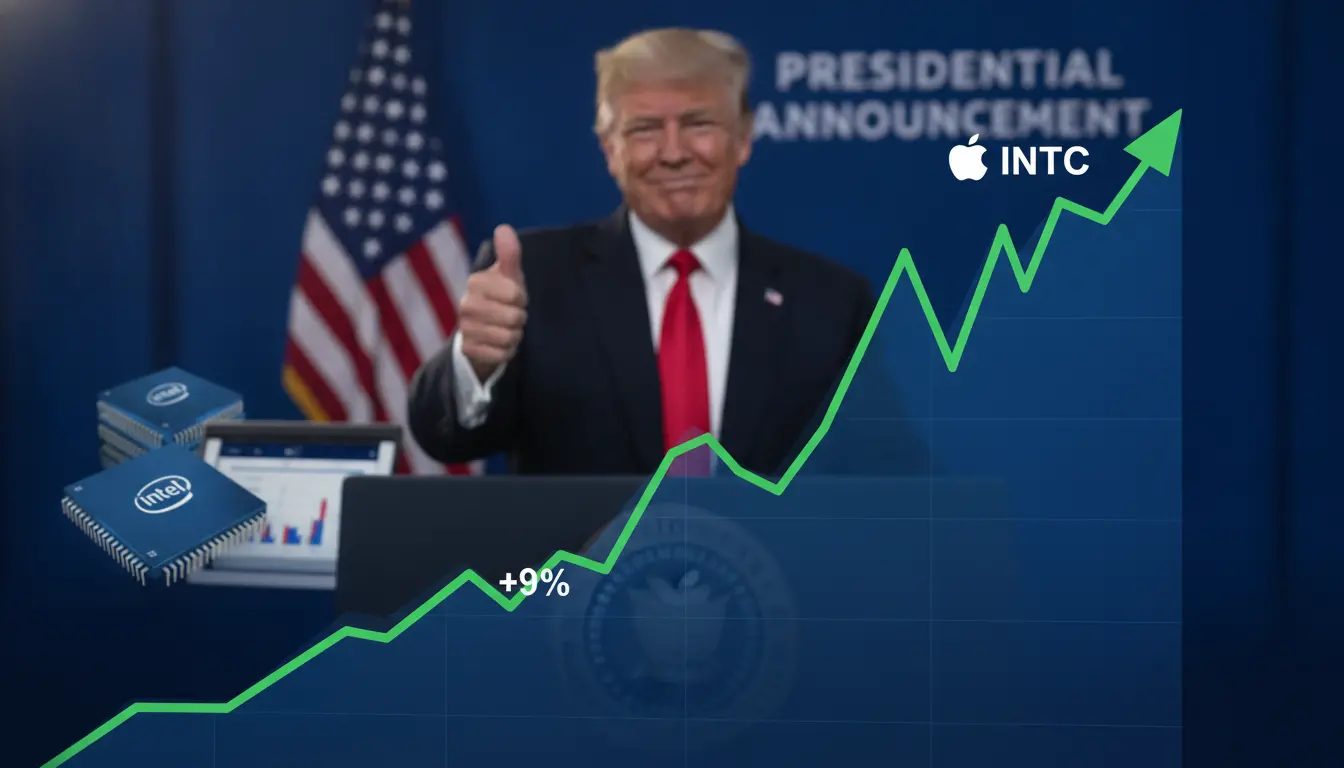
Intel Shares Soar After Trump Says It Struck Apple Chip Deal
Intel Corp.’s stock witnessed a dramatic surge in premarket trading on Thursday, climbing more than 9% following an announcement from then-US President Donald Trump. The former President asserted that the venerable chipmaker had entered into an agreement with Apple Inc. to jointly design and manufacture advanced semiconductors domestically, a move that, if confirmed, would represent a seismic shift in the technology supply chain and a significant boon for American manufacturing ambitions.
The pronouncement, coming from a figure known for his focus on American industrial policy, immediately sent ripples through the financial markets. Investors reacted with palpable enthusiasm to the prospect of Intel securing a high-profile manufacturing contract from Apple, a company that famously transitioned away from Intel’s processors for its Macs just a few years prior. This potential collaboration underscores a complex narrative of corporate strategy, national security imperatives, and a renewed push for onshore technology production, particularly in the critical semiconductor sector. For Intel, which has been striving to regain its technological leadership and establish a robust foundry business, an Apple deal would be a monumental validation.
Apple's current chip strategy largely revolves around its custom-designed, Arm-based M-series silicon, which powers its Mac computers, iPads, and iPhones. The production of these sophisticated chips has primarily been entrusted to Taiwan Semiconductor Manufacturing Company (TSMC), a global foundry powerhouse. Apple’s decision to develop its own silicon marked a pivotal moment, allowing for tighter integration between hardware and software and superior performance, but also deepening its reliance on offshore manufacturing. A shift, even partially, to domestic production with Intel would signal a significant strategic pivot for Apple, potentially driven by geopolitical considerations, supply chain resilience, or attractive incentives linked to domestic manufacturing.
Intel, under CEO Pat Gelsinger, has aggressively pursued a strategy to reclaim its leadership in chip manufacturing, including launching its Intel Foundry Services (IFS) division. This initiative aims to produce chips for external clients, directly competing with industry titans like TSMC and Samsung. Securing a contract with a client as prestigious and demanding as Apple would not only provide a massive revenue stream but also lend immense credibility to Intel’s foundry capabilities and its ambitious roadmap to regain process technology leadership. The symbolic weight of bringing Apple's advanced chip production to US soil, as championed by the previous administration, would also be a significant public relations victory, aligning with broader national interests to bolster American technological independence.
However, the path to such a collaboration is fraught with complexities and has historically been met with skepticism. Apple is known for its meticulous control over its supply chain and its high standards for manufacturing precision and efficiency. Integrating Intel into its established chip production ecosystem would require overcoming significant technical, logistical, and cultural hurdles. While President Trump's statement implies a definitive agreement, details regarding the scope, scale, and timeline of such a deal remain opaque. Past announcements regarding major tech collaborations have often required extensive follow-up and confirmation from the companies involved to fully materialize.
The potential implications for the broader semiconductor industry are profound. A partnership between Intel and Apple on domestic chip production could catalyze further investments in US manufacturing infrastructure, potentially drawing more companies to onshore their production facilities. This aligns with the objectives of legislative efforts like the CHIPS and Science Act, which aims to provide substantial incentives for semiconductor manufacturing and research within the United States. While the immediate market reaction reflects investor optimism about Intel's resurgence, the long-term success of such a high-stakes partnership will ultimately depend on its meticulous execution and the ability of both tech giants to navigate a rapidly evolving geopolitical and technological landscape.
Stay Informed. Act Smarter.
Get weekly highlights, major headlines, and expert insights — then put your knowledge to work in our live prediction markets.
Related News

Federal Officials Probe White House Staffer Over Alleged Insider Financial Gains from Trump Speeches

White House Teleprompter Operator Under Federal Investigation for Alleged Market Manipulation

Tehran Rejects Trump's Claim of 'Highest Level' Nuclear Inspection Agreement Amid Sanctions Relief Talks

US-Iran Tensions Escalate as Potential Military Options Against Nuclear Program Surface

South Korea Sets Ambitious $700 Billion Export Target Driven by AI Semiconductor Boom
AI Logistics Firm NASN Intelligent Tech Sets August 7 Debut, Posing Key Test for Tepid IPO Market

xAI Reportedly Developing Grok 5, a Massive 6 Trillion Parameter AI Model, for Public Access

Federal Investigation Launched into Close Encounter Between Presidential Support Osprey and Corporate Jet Near Reagan National

Leading AI Innovators OpenAI and Anthropic Eye Public Markets Amid Valuation Surge

US-Venezuela Talks Intensify Over Potential New Oil Drilling Rights for American Firms