

- News
- Finance
- Federal Reserve's Long-Term Strategy Under Scrutiny as Analysts Project Path to 2026 Rate Decisions

Federal Reserve's Long-Term Strategy Under Scrutiny as Analysts Project Path to 2026 Rate Decisions
WASHINGTON — While financial markets remain fixated on the Federal Reserve's every move in the short term, a more complex and consequential debate is unfolding among economists and policymakers about the central bank's long-term trajectory. With the most aggressive rate-hiking cycle in four decades now seemingly in the rearview mirror, attention is shifting from if the Fed will cut interest rates to when and how fast. The path toward a potential policy pivot by mid-2026 is emerging as a critical focal point, dependent on a delicate interplay of inflation, employment, and overall economic growth.
The Federal Open Market Committee (FOMC), led by Chair Jerome Powell, has consistently emphasized a data-dependent approach, vowing to maintain its restrictive stance until it is confident that inflation is sustainably returning to its 2% target. This mantra of “higher for longer” has guided policy through a period of stubborn price pressures. The benchmark federal funds rate currently sits in a range of 5.25% to 5.50%, a two-decade high designed to cool demand and temper economic activity. The success of this policy is evident in the headline inflation numbers, which have fallen significantly from their 2022 peaks, yet core inflation metrics have proven more persistent, complicating the timeline for any potential easing.
For the Fed to begin reducing its target rate by July 2026, a specific sequence of economic developments would need to unfold. Foremost among them is the continued disinflationary trend. Economists project that for the FOMC to act, core Personal Consumption Expenditures (PCE), the Fed's preferred inflation gauge, would need to be firmly anchored at or below the 2% target for several consecutive quarters. This would provide the necessary evidence that inflationary pressures have been fully wrung out of the system and are not at risk of re-accelerating once monetary policy becomes more accommodative.
Equally important is the state of the labor market. A key objective of the Fed's current policy is to achieve a “soft landing”—taming inflation without triggering a sharp rise in unemployment and a deep recession. So far, the job market has shown remarkable resilience, with unemployment remaining historically low. However, a gradual softening would be a welcome sign for policymakers. A scenario where job growth moderates to a more sustainable pace and wage growth aligns with productivity gains would signal that the economy is rebalancing, giving the Fed the green light to normalize interest rates. Conversely, a sudden spike in unemployment could force the central bank to cut rates more aggressively, a situation it would prefer to avoid.
Looking ahead to 2026, the Fed's decisions will be shaped by a confluence of factors beyond domestic inflation and employment. Global economic conditions, geopolitical tensions, and ongoing supply chain realignments could all introduce unexpected shocks. The path of fiscal policy in the United States will also be a critical variable; continued high levels of government spending could work at cross-purposes with the Fed's efforts to control inflation. The Fed's own projections, released quarterly in its Summary of Economic Projections or “dot plot,” will offer a running commentary on how policymakers’ views are evolving, but these are forecasts, not promises.
Analysts are currently split on the exact timing and pace of future cuts. Hawkish observers caution that cutting rates prematurely could reignite inflation, undoing the painful work of the past two years. They point to the persistent strength in consumer spending and services inflation as reasons for continued vigilance. On the other hand, more dovish commentators argue that holding rates too high for too long risks tipping the economy into an unnecessary recession. They contend that by mid-2026, the cumulative effects of tight monetary policy will have sufficiently cooled the economy, making rate cuts both appropriate and necessary to sustain the expansion. Ultimately, the road to July 2026 is long and filled with uncertainty, with every incoming data point set to be scrutinized for clues about the future of American monetary policy.
Stay Informed. Act Smarter.
Get weekly highlights, major headlines, and expert insights — then put your knowledge to work in our live prediction markets.
Related News
Federal Reserve's Rate Cut Prospects by 2026 Hinge on Evolving Inflation and Growth Data
Fed Grapples With Long-Term Rate Outlook as 'Higher for Longer' Mantra Tested by Economic Data
US Federal Reserve's Long-Term Interest Rate Path Under Intense Scrutiny

Federal Reserve Prepares for Critical July 2026 Rate Decision Amid Evolving Economic Landscape
Fed Signals Potential July Rate Cut as Inflation Cools and Growth Slows

Federal Reserve Eyes Steady Rates for September 2026 FOMC Meeting Amid Evolving Economic Data
Federal Reserve's Long-Term Inflation Battle Intensifies Ahead of July 2026 Core PCE Report
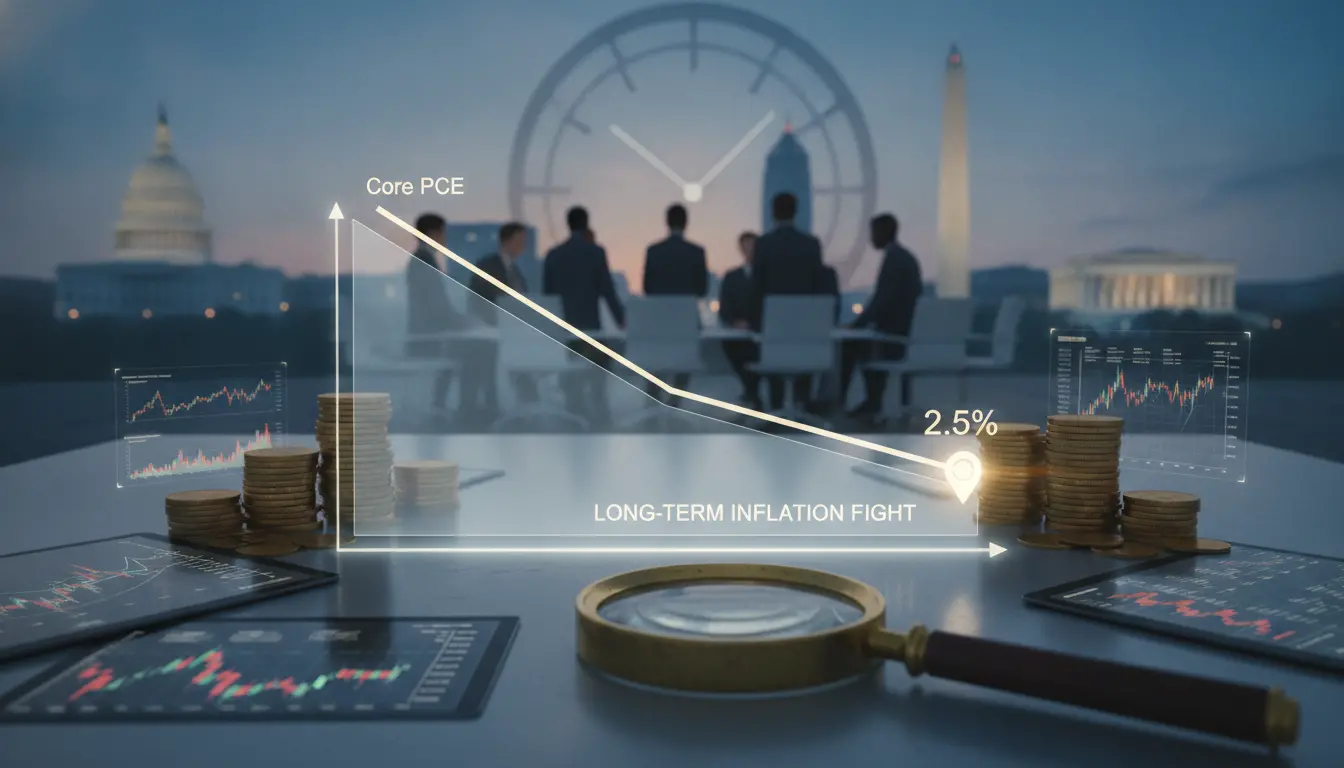
Fed’s Long-Term Inflation Fight Eyes 2.5 Percent Core PCE as Key Milestone
Economists Intensify Debate on US Recession Risk Through 2026 Amid Fed's Inflation Fight
US Economic Outlook for 2026 Hinges on Inflation Control and Productivity Revival