

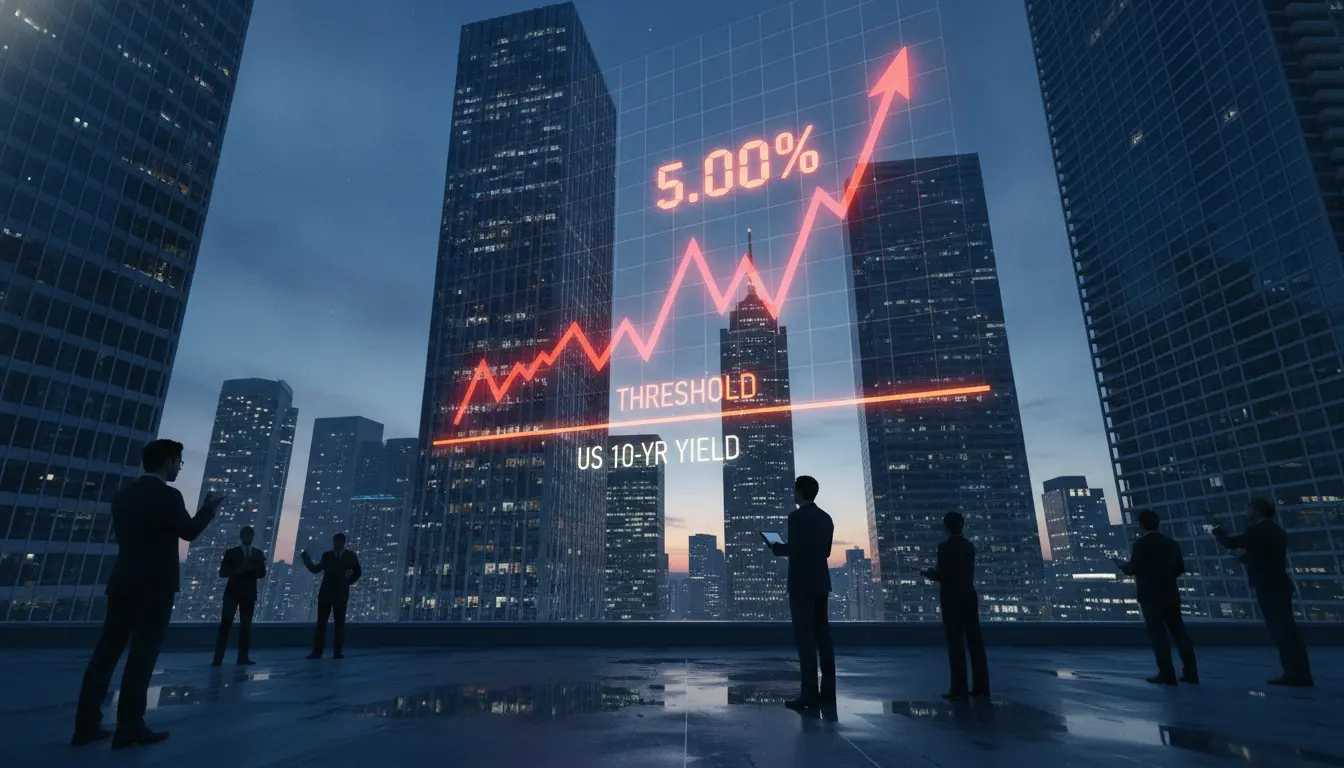
Analysts Eye US 10-Year Treasury Yield for Potential Breach of 5% Threshold
The US 10-year Treasury yield, a critical benchmark for global financial markets, is once again drawing significant attention as analysts and investors debate the prospects of it crossing the 5% threshold. This key rate, which influences everything from mortgage rates and corporate borrowing costs to international capital flows, has seen considerable volatility in recent years, reflecting shifting economic realities and evolving monetary policy stances. The possibility of the yield reaching or exceeding 5% by late 2026 underscores persistent inflationary pressures, robust economic activity, and the Federal Reserve’s commitment to maintaining a restrictive financial environment for longer than previously anticipated.
The 10-year Treasury yield serves as a barometer for long-term economic expectations, incorporating market views on inflation, economic growth, and the future path of the Federal Reserve’s benchmark interest rate. Its movements are closely watched because it acts as the risk-free rate against which many other assets are priced. A sustained rise in this yield typically signals higher borrowing costs across the economy, impacting government debt servicing, corporate investment, and consumer spending. Historically, yields above 5% have often been associated with periods of high inflation or aggressive monetary tightening, scenarios that define the current macroeconomic landscape.
Several interconnected factors could contribute to the 10-year yield breaching the 5% mark. Primary among these is the trajectory of inflation. While headline inflation metrics have cooled from their 2022 peaks, core inflation, excluding volatile food and energy prices, has proven more stubborn, leading the Federal Reserve to adopt a "higher for longer" stance on interest rates. Additionally, stronger-than-expected economic growth, defying predictions of a significant slowdown, could also exert upward pressure on yields, as a resilient economy might warrant less monetary accommodation. The sheer volume of US government debt issuance, needed to finance ongoing fiscal deficits, also plays a role, as increased supply in the bond market can depress prices and thus elevate yields.
A persistent 5% or higher 10-year Treasury yield would have profound implications. For the housing market, it would likely translate into higher mortgage rates, further dampening affordability and potentially slowing real estate activity. Businesses would face increased costs for capital, potentially curbing expansion plans and impacting corporate profitability. Globally, a higher US yield makes dollar-denominated assets more attractive, potentially drawing capital away from emerging markets and strengthening the dollar, which can create headwinds for countries with significant dollar-denominated debt. The US government itself would also face substantially higher interest payments on its burgeoning national debt, further straining the federal budget.
The Federal Reserve’s future monetary policy decisions remain central to the yield’s trajectory. Should inflation prove more intractable or economic growth surprisingly robust, the Fed might be compelled to either raise rates further or maintain them at elevated levels for an extended period, reinforcing the upward pressure on long-term yields. Conversely, any signs of significant economic weakness or a more rapid disinflationary trend could prompt the Fed to consider rate cuts, which would typically ease long-term yields. The market's interpretation of economic data, Fed communications, and geopolitical events will continue to drive day-to-day fluctuations, but the long-term trend appears to be shaped by deep structural forces.
Investors are grappling with an environment where the traditional relationship between interest rates and economic performance is being re-evaluated. The prospect of the US 10-year Treasury yield sustaining levels above 5% through late 2026 signals a potential paradigm shift in global finance, moving away from the ultra-low rate environment that characterized much of the post-2008 era. This scenario necessitates a recalibration of investment strategies across asset classes, with implications for portfolio construction, risk management, and the valuation of long-duration assets. As the economic landscape continues to evolve, the 10-year Treasury yield will remain a critical indicator of market sentiment and the broader economic outlook.
Stay Informed. Act Smarter.
Get weekly highlights, major headlines, and expert insights — then put your knowledge to work in our live prediction markets.
Related News

Outlook for US 10-Year Treasury Yield Above 5% Signals Deepening Economic Worries

US Federal Reserve's Long-Term Interest Rate Path Under Intense Scrutiny

Analysts Eye Potential Rise in US Unemployment Rate as Federal Reserve Navigates Economic Crossroads

Federal Reserve's Long-Term Strategy Under Scrutiny as Analysts Project Path to 2026 Rate Decisions

Federal Reserve's Long-Term Inflation Battle Intensifies Ahead of July 2026 Core PCE Report

Fed Grapples With Long-Term Rate Outlook as 'Higher for Longer' Mantra Tested by Economic Data

Economists Intensify Debate on US Recession Risk Through 2026 Amid Fed's Inflation Fight

US Economic Outlook for 2026 Hinges on Inflation Control and Productivity Revival

US Dollar Index Faces Persistent Weakening Trend Amid Global Economic Realignments

US Core PCE Inflation Accelerates to 3.4% in May, Heightening Federal Reserve Policy Concerns