- News
- Entertainment
- Dreams of Violets Review: What Does a Film Made Entirely with AI Look Like? Ash Koosha’s Iranian Protest Drama Is Dramatically Numbing, but It’s Still a Startling Portent of the Future
Dreams of Violets Review: What Does a Film Made Entirely with AI Look Like? Ash Koosha’s Iranian Protest Drama Is Dramatically Numbing, but It’s Still a Startling Portent of the Future
The question of whether artificial intelligence can truly create art has lingered on the fringes of technology and culture for years, but with Ash Koosha’s ‘Dreams of Violets,’ the question is no longer theoretical. Billed as the first feature film generated entirely with AI tools, this experimental Iranian protest drama is a landmark achievement, though perhaps not in the way its creators intended. It is at once a visually hypnotic and emotionally vacant experience, a technological marvel that serves as a profound, if often tedious, glimpse into the future of filmmaking. While it may be a dramatically numbing affair, its existence alone is a startling portent, a line drawn in the sand that separates the era of traditional cinema from whatever comes next.
At the helm of this audacious project is Ash Koosha, an Iranian-born, London-based electronic musician and conceptual artist whose work has consistently explored themes of identity, displacement, and political unrest. His choice of subject matter—a surreal depiction of the Woman, Life, Freedom movement in Iran—is deeply personal and politically charged. Koosha fed text prompts into a series of generative AI models, acting less as a director in the traditional sense and more as a digital conjurer, summoning images from the ether of the algorithm. His goal was to craft a narrative of resistance and memory, but the very tools he used have imposed a strange, dreamlike logic onto the proceedings, creating a film that feels both immediate in its imagery and utterly detached in its storytelling.
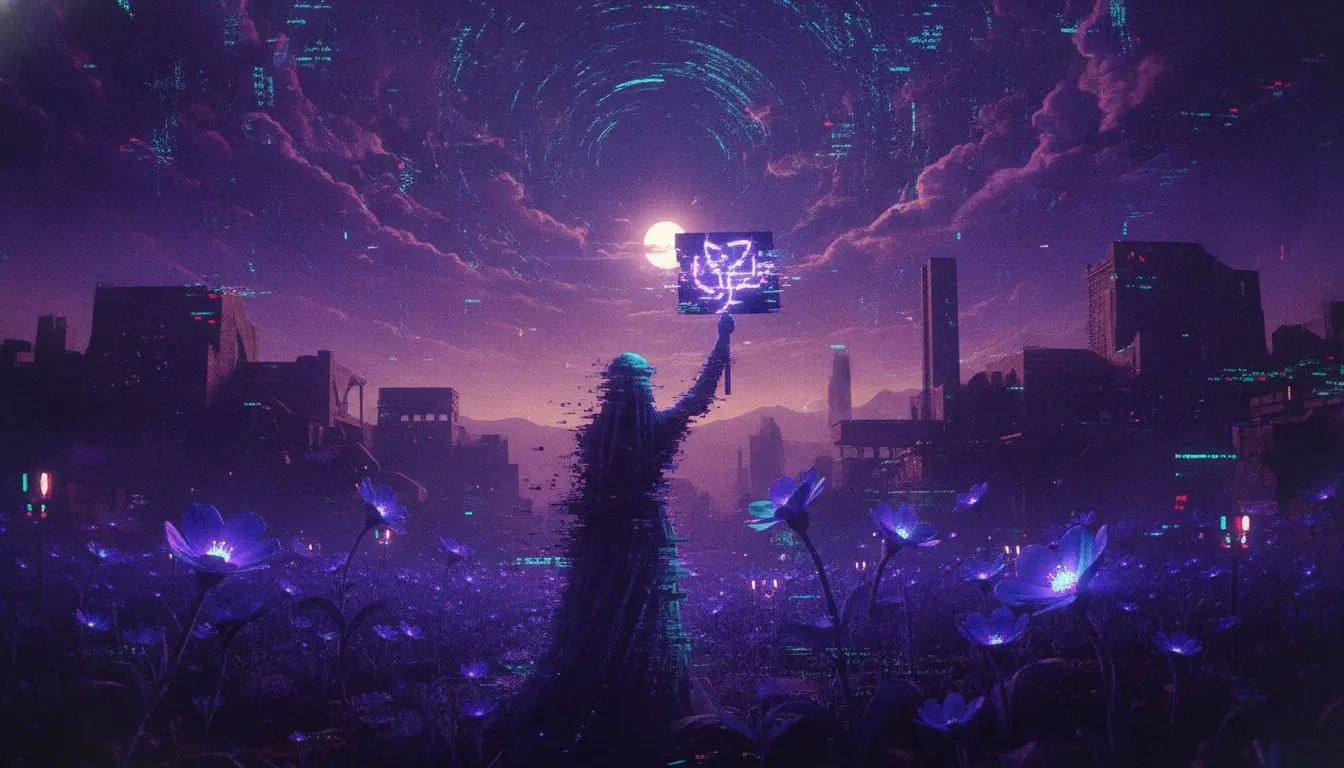
The film’s undeniable power lies in its aesthetic. The AI delivers on the promise of creating scenes of almost unimaginable complexity and detail. It can, as if on command, give you roiling, tumultuous civil conflict set in the hurly-burly of Tehran at sunset. The screen fills with hauntingly beautiful, perpetually morphing tableaus of soldiers roaming the streets, forcing citizens into vans as others scurry from the encroaching darkness. There is a painterly quality to these moments, a fluid, almost liquid texture to the world that makes you believe your eyes, even as the uncanny logic of the visuals whispers that something is deeply wrong. Faces subtly shift, architecture ripples, and the laws of physics seem optional, creating a potent visual metaphor for a society under duress, where reality itself feels unstable.
Yet, for all its visual splendor, ‘Dreams of Violets’ struggles to cohere into a compelling narrative. The film is a powerful testament to the current limitations of AI as a storyteller. While the technology can generate breathtaking images, it lacks the understanding of human experience necessary to build character, sustain dramatic tension, or imbue a scene with emotional resonance. The figures on screen are less characters than avatars, expressionless vessels drifting through Koosha’s curated chaos. The dialogue, also AI-generated, is stilted and often nonsensical, failing to forge the connections that would make the audience invest in the struggle depicted. This results in a viewing experience that is paradoxically stunning and boring, a technically brilliant slideshow of suffering that never manages to touch the soul.
So, does this mean that AI can “make a movie?” The answer, based on this evidence, is a definitive no. Not yet. What it can do is generate scenes, create worlds, and produce imagery that would be prohibitively expensive or logistically impossible for most human filmmakers. ‘Dreams of Violets’ is not a film in the conventional sense; it is an experimental art piece, a proof of concept that both showcases the incredible potential of generative video and lays bare its profound shortcomings. It succeeds not as a drama, but as a critical document marking a specific moment in technological and cinematic history—the moment AI became a viable, if flawed, tool for long-form visual creation.
Ultimately, the film’s greatest contribution is as a warning and an inspiration. It demonstrates that while the tools are becoming astonishingly sophisticated, the human element—the artist’s intent, the writer’s craft, the actor’s soul—remains the irreplaceable core of meaningful storytelling. But it also serves as a stark reminder of the velocity of change. What is today a “dramatically numbing” experiment could, within a few years of algorithmic evolution, become a powerful new genre of filmmaking. ‘Dreams of Violets’ may be a flawed and frustrating film, but it will be remembered as a crucial first draft, a ghostly and beautiful artifact from the dawn of a new cinematic age.
Stay Informed. Act Smarter.
Get weekly highlights, major headlines, and expert insights — then put your knowledge to work in our live prediction markets.