SciencearchaeologyExcavations and Discoveries
Dinosaur mummy found with hooves and a hidden crest
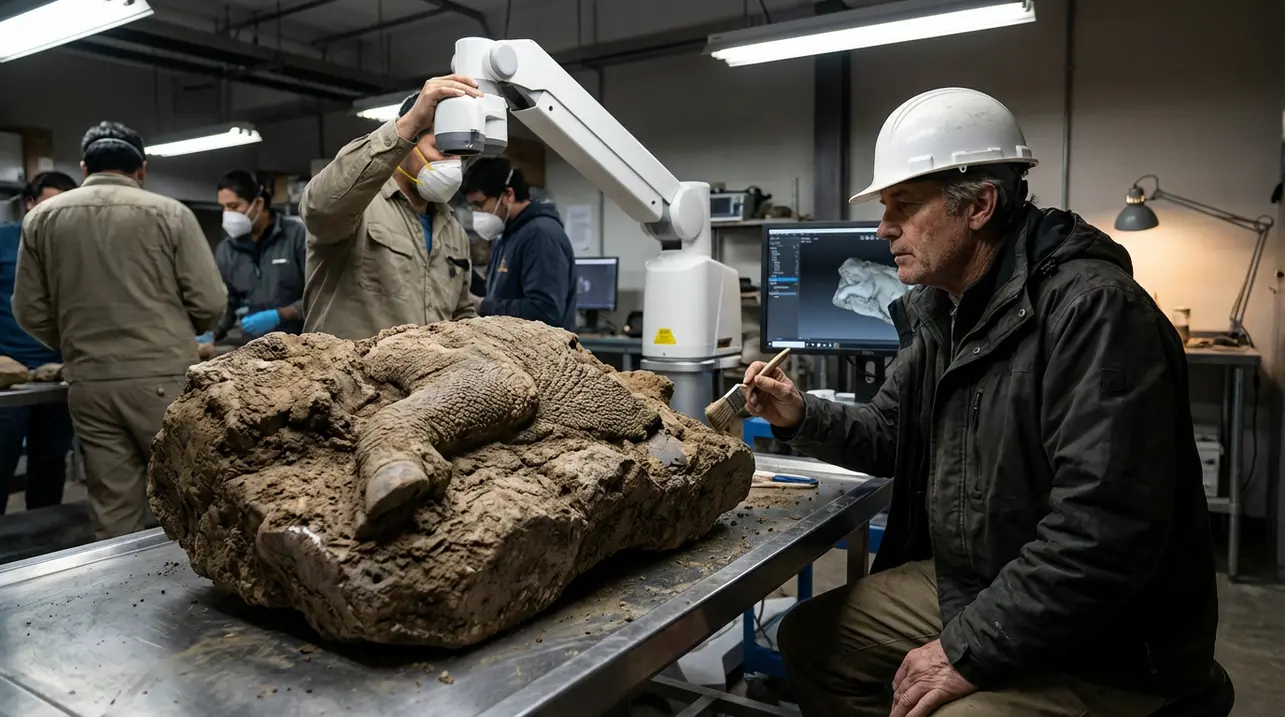
The discovery of a dinosaur mummy so exquisitely preserved it reveals hooves and a hidden crest isn't just a paleontological headline; it's a masterclass in preservation that rewrites our mental image of a giant from the Late Cretaceous. Scientists working with an Edmontosaurus annectens specimen have leveraged a freakish natural process called clay templating, where a thin film of fine-grained sediment acted like a perfect mold, capturing the three-dimensional topography of the dinosaur's skin, scales, and soft tissues with unprecedented fidelity.This isn't a flattened impression or a fragmentary fossil; it's a death mask in clay, a snapshot of integumentary reality from 66 million years ago. By combining this 'mummy' with advanced imaging techniques like laser scanning and CT, and then feeding that data into rigorous artistic reconstructions, the research team has produced the most complete and lifelike profile of this hadrosaur ever conceived.The revelations are profound, moving beyond speculative art into the realm of documented anatomy. The tall, fleshy crest running along the skull, previously unknown, suggests potential uses in display, species recognition, or even thermoregulation, adding a new layer of behavioral complexity to these so-called 'duck-billed' dinosaurs.The confirmation of a single, neat row of tail spikes, rather than a haphazard arrangement, speaks to a specific defensive or display adaptation. Most startling, however, are the hooves.The preservation clearly shows keratinous, hoof-like coverings on its digits, which now stand as the earliest definitive evidence of true hooves in any land vertebrate, pushing the evolutionary origin of this crucial adaptation back deep into the Age of Dinosaurs and blurring the line between reptilian scales and mammalian structures. This finding forces a reconsideration of locomotor adaptation in large, heavy herbivores, suggesting that the evolutionary pressures that led to hooves in ungulates were already in play in the dinosaurian predecessors that dominated terrestrial ecosystems.The implications extend beyond a single species. The clay templating process itself, a serendipitous combination of rapid burial in an anoxic, fine-sediment environment, opens a new window into taphonomy—the study of fossilization.It provides a roadmap for what to look for in future digs, suggesting that other 'ordinary' fossil beds might contain similar three-dimensional skin envelopes waiting to be recognized and scanned. For biotech and evolutionary developmental biology enthusiasts, this is a treasure trove.The detailed scale patterns, the transition from pebble-like scales on the flanks to larger, more complex structures elsewhere, offer a real-world dataset for studying the genetic and developmental pathways of skin morphology. It's a fossil that speaks directly to modern research in Evo-Devo, asking how the genes that code for reptilian scales were modulated to produce such a diverse array of integumentary features, from the delicate pebbling to the robust hooves. This Edmontosaurus is no longer just a skeleton; it's a preserved organism, and its story challenges the static, leathery-skinned depictions in museum halls, replacing them with a dynamic, textured, and surprisingly familiar creature whose evolutionary innovations would echo for millions of years, ultimately in the hoofbeats of the mammals that inherited the Earth.
#featured
#dinosaur mummy
#Edmontosaurus
#clay templating
#fossil preservation
#hooves
#crest
#paleontology