Why AI coding agents aren't production-ready for enterprise work
DA
2 days ago7 min read
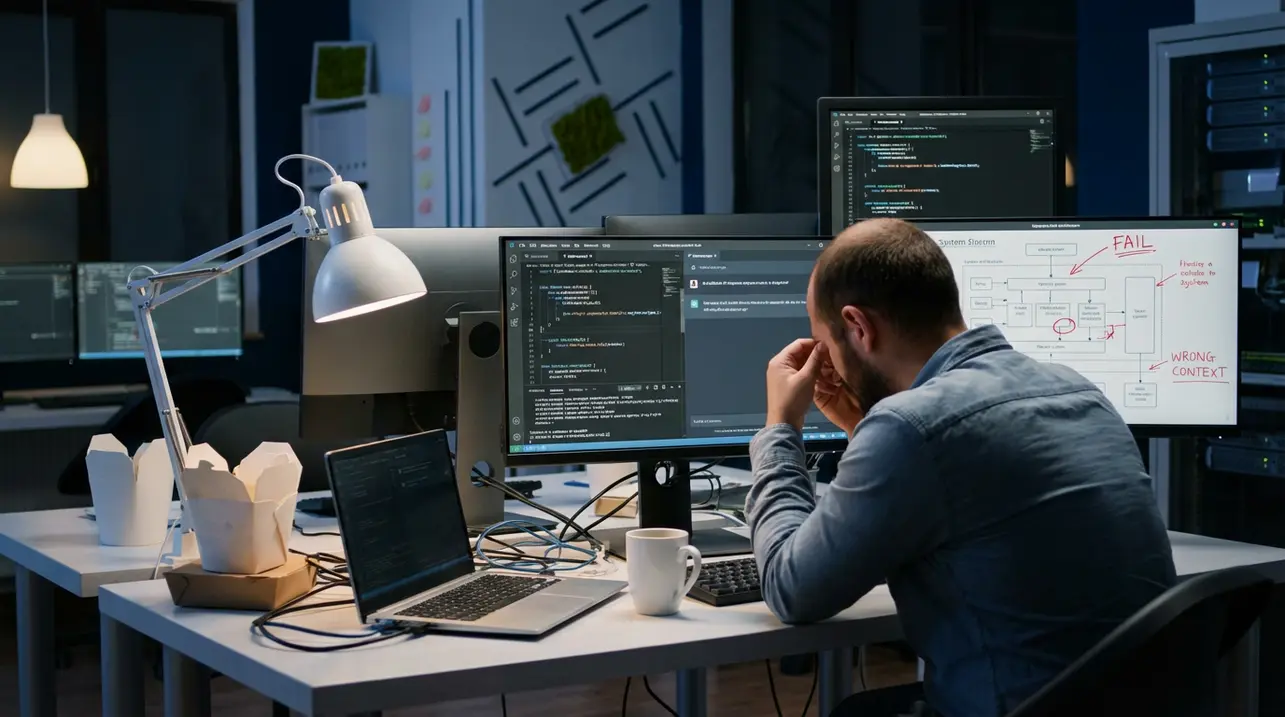
The promise of AI coding agents as autonomous software engineers is a compelling narrative, one that dominates tech keynotes and viral social media clips. Yet, beneath the surface of this rapid code generation lies a more complex and less glamorous reality for enterprise engineering teams.The fundamental shift isn't from writing code to prompting it; it's from implementation to a constant, vigilant orchestration of a powerful but deeply flawed assistant. The core issue mirrors an old programmer joke about copying from Stack Overflow: the hard part was never the copy-paste, but knowing which snippet to use and how to integrate it safely.Today, while generating a functional code block is trivial, the act of reliably weaving AI-produced code into a vast, mission-critical production environment—with its labyrinthine dependencies, stringent security protocols, and decades of technical debt—remains a formidable, often manual, challenge. These agents, for all their brilliance, exhibit critical failures in domain understanding.Enterprise codebases are living ecosystems, not isolated repositories. An agent tasked with modifying a billing service may brilliantly generate syntactically perfect Python, but it operates in a vacuum, blissfully unaware of the adjacent monolith handling user authentication or the internal governance policy that forbids client secrets in favor of federated identities.This lack of context is compounded by practical constraints: many tools simply fail to index repositories exceeding a few thousand files or choke on legacy code files larger than half a megabyte, effectively rendering them blind to the very history they need to understand. The problems escalate from architectural ignorance to operational friction.Agents demonstrate a startling lack of hardware and environmental awareness, attempting Linux commands in a PowerShell window or giving up on reading command output before a slow-running test has even finished. This necessitates what developers are now calling 'agent babysitting'—a state of real-time monitoring that defeats the promise of asynchronous productivity.You cannot, as the article notes, submit a prompt on a Friday and trust a working system on Monday. The agent might halt on a false-positive security flag, misidentifying a common version string in a configuration file as a malicious payload, and then, in a frustrating display of stubbornness, repeat the same error multiple times within a single session.This points to a deeper issue than mere hallucination: a brittleness in reasoning loops that forces engineers to discard context and start anew, burning tokens and time. Furthermore, the output often lacks the nuance of enterprise-grade practice.
#AI coding agents
#production readiness
#enterprise software
#development challenges
#featured
Stay Informed. Act Smarter.
Get weekly highlights, major headlines, and expert insights — then put your knowledge to work in our live prediction markets.
There's a tendency to default to outdated SDKs, generating verbose, v1-style code when cleaner, more maintainable v2 solutions exist. They miss opportunities for refactoring, producing repetitive logic even when a simple function extraction is obvious to a human engineer, thereby planting the seeds of future technical debt.
Perhaps most insidiously, these large language models exhibit a strong confirmation bias, often affirming a user's potentially flawed premise instead of challenging it—a dangerous trait when designing secure, scalable systems. The consequence is a subtle but significant shift in the developer's role.
As GitHub's Thomas Dohmke observed, the advanced developer is now an architect and verifier. The time saved in boilerplate generation is often reclaimed, and then some, in debugging, security review, and system integration.
The sunk cost fallacy becomes a real risk: an engineer may cling to a beautifully formatted but fundamentally broken AI-generated module, investing hours in fixes because the initial output *looked* so professional. In essence, collaborating with a state-of-the-art coding agent can feel like partnering with a phenomenally knowledgeable but impulsive intern—one who prioritizes demonstrating capability over solving the holistic problem.
For enterprise work, where scalability, maintainability, and security are non-negotiable, this makes current agents powerful prototyping aids but unreliable production engineers. The path forward isn't about better prompts; it's about building systems that can ingest and respect enterprise context, learn from repeated mistakes within a session, and adhere to modern architectural and security principles by default. Until then, their use requires strategic, guarded application, with human engineering judgment firmly in the driver's seat.