

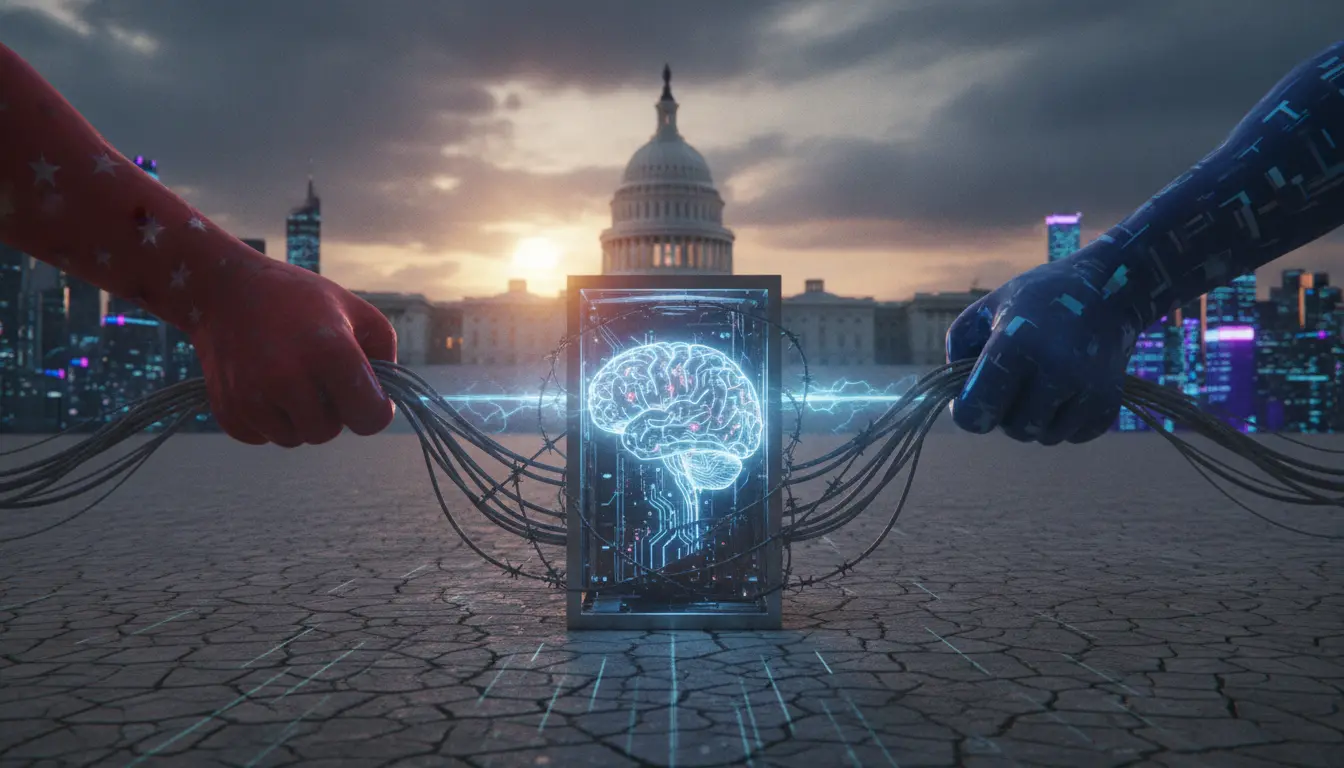
US Deepens AI Export Scrutiny, Sparking Fears of a New Tech Cold War
WASHINGTON — The Biden administration is escalating its campaign to control the global flow of advanced technology, signaling a significant expansion of export restrictions from computer chips to the powerful artificial intelligence models themselves. Following recent government pressure that curbed foreign access to technology from leading firm Anthropic, officials are now actively exploring broader rules that could prevent cutting-edge AI systems from falling into the hands of strategic rivals, a move that is rattling both Silicon Valley and international allies.
This new front in the technology competition represents a critical evolution of U.S. policy. For the past several years, the Commerce Department’s Bureau of Industry and Security (BIS) has focused its efforts on hardware, successfully orchestrating a campaign to deny China and other nations access to the high-performance semiconductors, like those made by NVIDIA, that are essential for training and running large-scale AI. Now, Washington’s national security apparatus has concluded that controlling the hardware is insufficient. The concern is that sophisticated, proprietary AI models — the complex algorithms and code that constitute the “brains” of the technology — could be acquired and repurposed by adversaries for malicious uses, including cyber warfare, autonomous weapons systems, or advanced surveillance.
Recent events surrounding San Francisco-based AI lab Anthropic have served as a test case and a harbinger of this policy shift. The U.S. government intervened over concerns about potential foreign influence, specifically related to an investment from a venture capital fund backed by Saudi Arabia's state oil company. This scrutiny reportedly contributed to a corporate restructuring to ensure that sensitive technology and governance remained securely under U.S. control. While the details remain closely held, the episode sent a clear message: Washington is not only watching who builds the most advanced AI but also who invests in it and who can access it. The action has been interpreted across the industry as a prelude to more formal, wide-ranging regulations.
The central challenge for policymakers is drawing a line in the sand. The administration’s strategy has been described as a “small yard, high fence” approach, aiming to restrict only the most critical technologies while allowing broader commerce to continue. However, defining what constitutes a “dangerous” or “advanced” AI model is fraught with technical and political difficulty. Officials are grappling with whether to base restrictions on the amount of computing power used to train a model, its specific capabilities (such as complex scientific reasoning or code generation), or other benchmarks. Any such rule would have profound implications, potentially affecting the booming open-source AI movement and the ability of American companies to collaborate with international researchers and customers.
This potential expansion of export controls has triggered a tense debate. National security hawks argue that unchecked proliferation of top-tier AI models poses an existential threat, akin to the spread of nuclear or chemical weapons technology. They contend that the U.S. must act decisively to maintain its technological lead and prevent authoritarian regimes from weaponizing American innovation. On the other side, many in the tech industry and some within the administration caution that overly broad restrictions could backfire spectacularly. They argue that such controls would stifle innovation, cede global market leadership to foreign competitors, and alienate key allies in Europe and Asia who are vital partners in developing responsible AI norms.
International reaction has been a mixture of cautious understanding and growing anxiety. Allies like the United Kingdom, South Korea, and the European Union share many of the U.S. concerns about China's technological ambitions but worry they could be caught in the crossfire. They are heavily reliant on U.S. cloud infrastructure and AI models, and any unilateral American restrictions could disrupt their own economic and security initiatives. The fear is that a U.S.-led “tech blockade” could splinter the global technology ecosystem, forcing countries to choose sides and accelerating a costly and destabilizing digital decoupling.
As the Commerce Department continues its review, the global tech community is holding its breath. The decisions made in Washington over the coming months will not only define the competitive landscape for companies like OpenAI, Google, and Anthropic but could also set the course for international technological cooperation for years to come. The question is no longer if the U.S. will regulate AI exports, but how far it will go, and whether it can erect a high fence around its most prized digital assets without walling itself off from the world.
Stay Informed. Act Smarter.
Get weekly highlights, major headlines, and expert insights — then put your knowledge to work in our live prediction markets.
Related News
US Congress Intensifies Efforts to Forge Comprehensive Federal AI Regulation

G7 Intensifies Push for Global AI Rules, But Path to Unified Framework Remains Complex

Tech Giants Escalate High-Stakes Race for Next-Generation AI Models

Leading AI Labs Intensify Proprietary Chip Development Drive

Major Cloud Providers Face Power Grid Headwinds Threatening AI Data Center Expansion

Global AI Leaders Vie to Unveil Next-Generation Large Language Models

The Race for AI Supremacy: Tech Giants Accelerate Timelines for Next-Generation Language Models

Major AI Companies Intensify Race to Unveil Next-Generation Flagship Language Models

AI Race Accelerates as Tech Giants Push for Next-Generation Flagship Models

Global Tech Giants Accelerate Development of Next-Generation Flagship AI Models