

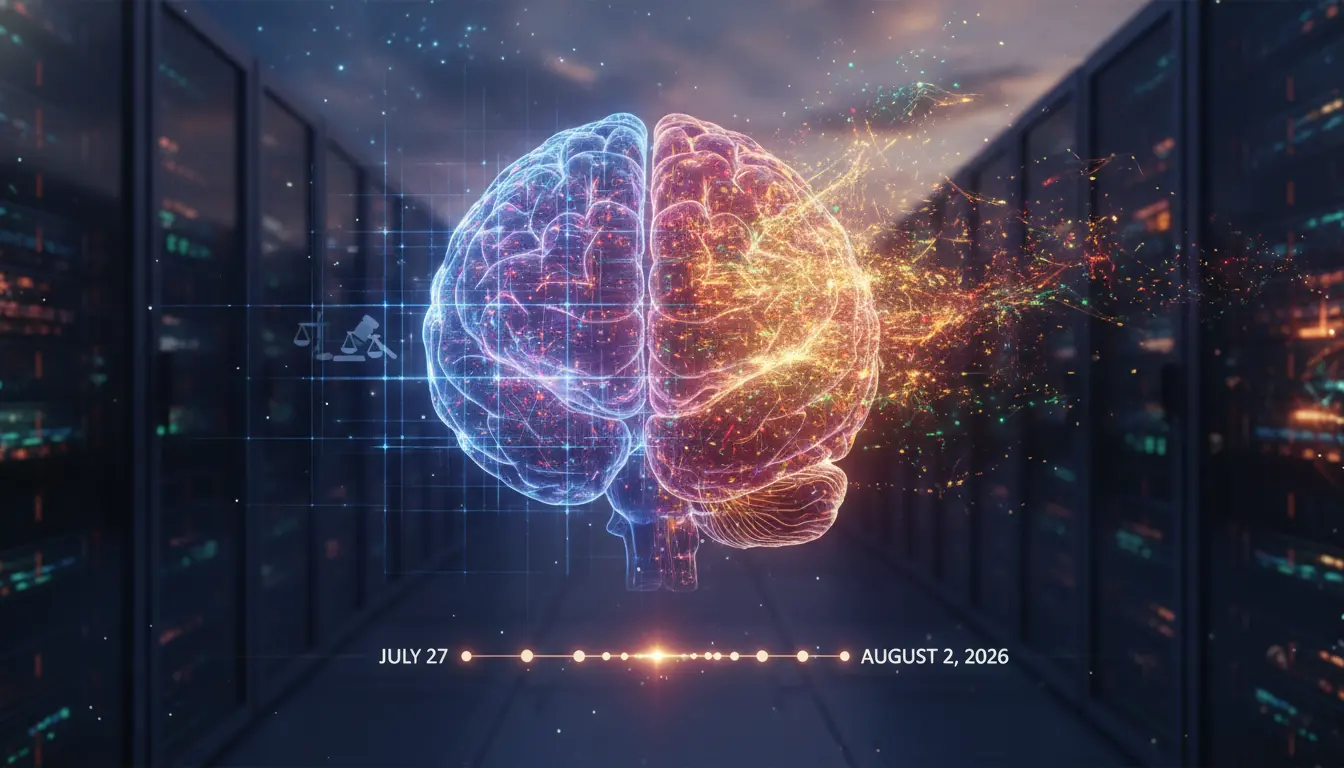
Outpoll Weekly Recap: AI (July 27 – August 2, 2026)
This week in AI felt less like a slow summer stretch and more like the calm before a paradigm shift—if you were glued to prediction markets and research feeds, the signals were impossible to ignore. The headline mover was OpenAI’s quiet release of a mid-tier reasoning model, reportedly dubbed “GPT-5-mini” internally, which shot to the top of the LMArena leaderboard within 48 hours and triggered a flurry of speculative betting on the timing of full GPT-5 deployment. Predictive platforms like Polymarket and Metaculus saw a sharp repricing of the “AGI by 2030” question, with confidence ticking up from 58% to 63%—a jump that many attributed not to any single breakthrough but to the compounding effect of open-source progress. DeepSeek’s new MoE architecture, published without fanfare on arXiv, quietly became the most-forked repository on Hugging Face by midweek, and its efficiency numbers have reignited the eternal debate: are we approaching the scaling ceiling, or just the ceiling of brute-force compute? Meanwhile, the EU’s AI Office dropped a draft of its high-risk classification guidelines, and the market reaction was telling—not panic, but a pragmatic shuffle. Betting odds on “EU AI Act delay beyond 2027” climbed to 71%, up from 54% last month, as industry lobbyists argued that the framework’s definitions are already outdated relative to what open-weight models can do. On the research front, a Stanford team published a paper on sparse autoencoders that reportedly cracks open the black box of multi-step reasoning better than any prior interpretability work; the paper hasn’t been peer-reviewed yet, but the rumor mill suggests at least two major labs are already building on it. And in the hardware lane, Nvidia’s leaked Blackwell Ultra specs dominated chatter on r/LocalLLaMA, but the more interesting prediction-market movement was around AMD’s MI500—a dark horse that briefly flipped the “next big AI chip” market to 50/50 before settling back. What struck me most this week wasn’t any single announcement, though. It was the widening gap between the public narrative—still dominated by doomer headlines and safety panels—and the actual velocity of open-source tooling, tiny model optimizations, and decentralized training experiments. The markets see it, the grad students see it, and the investors are quietly rebalancing their portfolios around it. If I had to distill the week into a thesis: we’re not waiting for a magic breakthrough anymore; we’re waiting for the ecosystem to reorganize around what already works. And if the prediction curves are any indication, that reorganization is accelerating faster than most official timelines admit.
Stay Informed. Act Smarter.
Get weekly highlights, major headlines, and expert insights — then put your knowledge to work in our live prediction markets.
Related News



Outpoll Weekly Recap: AI (August 17 – 23, 2026)

Outpoll Weekly Recap: Entertainment (June 29 – July 5, 2026)
Outpoll Weekly Recap: Finance (August 10 – 16, 2026)

Outpoll Weekly Recap: Entertainment (June 22 – 28, 2026)
Outpoll Weekly Recap: Science (August 3 – 9, 2026)