

AIcomputer vision
Meta's New AI Learns the World's Physics by Watching Videos
DA
Daniel Reed
6 months ago7 min read
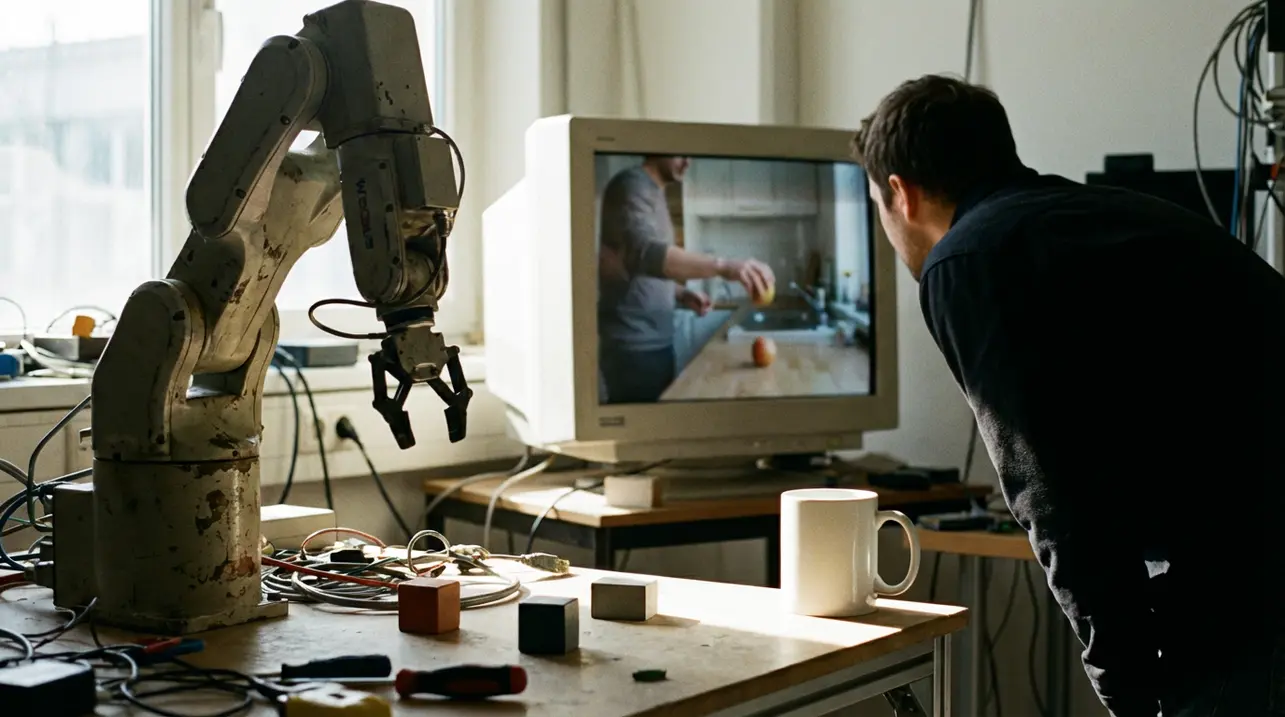
Meta AI's unveiling of the Video Joint Embedding Predictive Architecture (V-JEPA) signals a fundamental evolution in artificial intelligence. The model departs from the text-heavy training of large language models, instead learning by observing unlabeled, everyday videos.Its breakthrough lies in a unique predictive task: rather than guessing missing pixels, V-JEPA predicts missing video segments within a high-level abstract representation. This compels the AI to construct an internal model of physical plausibility.For example, when footage of a falling cup is hidden, the model must infer the cup's trajectory, its likely breakage, and the spillage of liquid based on learned principles of gravity, object permanence, and material behavior. This research, rooted in Yann LeCun's vision for autonomous intelligence, aims to create systems with causal, intuitive world models—a critical ability absent in today's pattern-matching LLMs.The potential applications are significant. In robotics, such an AI could learn intricate manipulation tasks from video demos with greater efficiency, grasping the physical rationale behind actions.For self-driving cars, it could improve anticipation of pedestrians or road hazards by understanding their physical constraints. The approach also promises greater data efficiency, using the endless stream of online video as a training ground and lessening dependence on expensively labeled datasets.Yet, hurdles persist. Current capabilities are limited to short timeframes and simple interactions.Scaling to comprehend long, complex causal chains remains a major challenge. Moreover, the model's 'intuition' is a sophisticated statistical approximation, not a deep mechanistic understanding like human cognition.Ethically, this advance intensifies discussions on AI safety and embodiment. An AI with an intuitive grasp of physics is a powerful tool that could drive assistive technologies or, if misaligned, become a more capable and unpredictable agent.As labs like DeepMind and OpenAI explore similar self-supervised learning, V-JEPA serves as a pivotal milestone. It proves that the journey toward more general AI may require not just larger language models, but systems grounded in the foundational physics of our world—a lesson humanity learns early, and is now teaching its machines.
#V-JEPA
#AI research
#computer vision
#physics understanding
#video analysis
#self-supervised learning
#featured
Stay Informed. Act Smarter.
Get weekly highlights, major headlines, and expert insights — then put your knowledge to work in our live prediction markets.
Related News







1 month ago
Billy Corgan and Diplo debate AI use in music industry.
1 month ago
Black Forest Labs' Self-Flow makes AI training 2.8x more efficient
1 month ago
Meta and Broadcom Extend AI Chip Partnership to 2029
1 month ago
Outpoll Weekly Recap: Entertainment (April 20 – 26, 2026)

1 month ago
Outpoll Weekly Recap: AI (April 20 – 26, 2026)
Comments
It's quiet here...Start the conversation by leaving the first comment.