AIroboticsDrone Technology
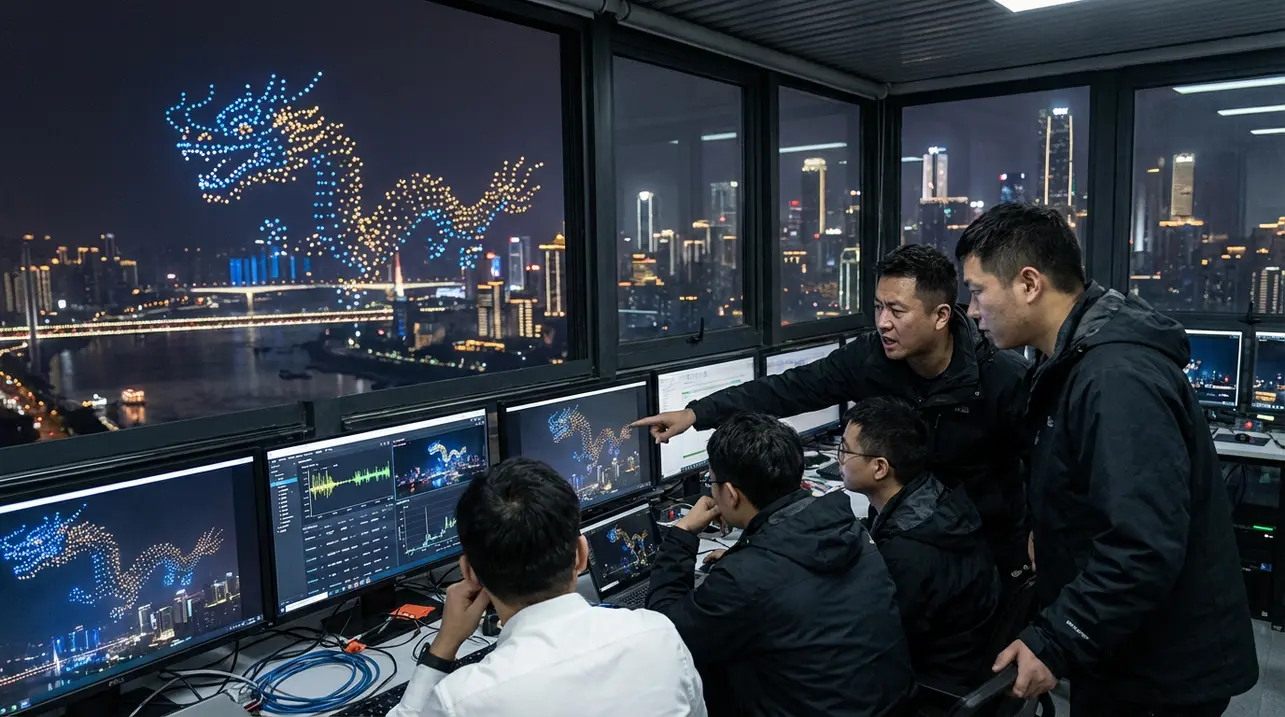
Chinese Team Controls Thousands of Drones with One Computer in Chongqing Show
The recent drone light show over Chongqing’s skyline, where a single computer orchestrated thousands of unmanned aerial vehicles in perfect, luminous synchronicity, is far more than a dazzling spectacle for tourists. It is a profound technical statement, a live demonstration of China’s accelerating edge in swarm robotics and automated control systems.To understand the significance, one must look past the shimmering formations of dragons and maps and peer into the underlying architecture. This isn't merely about scaling up a light show; it's a stress test for the algorithms governing collective autonomy.The core challenge in managing such a massive swarm isn't just about sending simultaneous commands—it's about real-time coordination, collision avoidance, and dynamic path planning in a chaotic, three-dimensional airspace. A failure in one node's positioning data or a lag in communication could cascade into a catastrophic mid-air pile-up.The fact that this was executed flawlessly from a single command center suggests remarkable advances in both the robustness of the local network protocols—likely a hybrid of 5G and proprietary mesh networking—and the fault tolerance baked into the fleet's decision-making logic. We can draw a direct line from this public display to more consequential applications.Militarily, this technology underpins the concept of drone swarms for surveillance, electronic warfare, or even coordinated strikes, where decentralized yet cohesive action is paramount. Commercially, it validates the feasibility of large-scale automated logistics, like deploying hundreds of delivery drones over a megacity or managing agricultural monitoring fleets across vast farmlands.The Chongqing demonstration quietly answers a critical question in distributed AI: how much centralization is optimal? Here, the 'brain' is singular, but the 'nervous system' is distributed across the swarm, allowing for both top-down orchestration and localized, reactive intelligence. This hybrid model may well become the blueprint for future human-AI collaborative systems, where a central agent sets the strategic objective while a multitude of semi-autonomous agents handle tactical execution.Observers in the West, particularly in defense and logistics sectors, will be analyzing the footage not for its artistic merit, but for clues about latency, formation transition speed, and recovery from simulated failures. The show is a benchmark, proving that the theoretical models for large-scale multi-agent systems are now operational at a breathtaking scale. It pushes the boundary of what we consider possible in real-world robotics, moving us incrementally closer to a future where intelligent machine collectives are a mundane part of our infrastructural fabric.
#featured
#drones
#automation
#swarm technology
#China
#Chongqing
#light show
#computer control