

- News
- Politics
- Texas Law Mandating Bible Stories in Public Schools Faces Immediate Federal Court Challenge Over Church-State Separation
Hottest
Politics
Texas Law Mandating Bible Stories in Public Schools Faces Immediate Federal Court Challenge Over Church-State Separation
AN
Anna Wright
19 hours ago7 min read
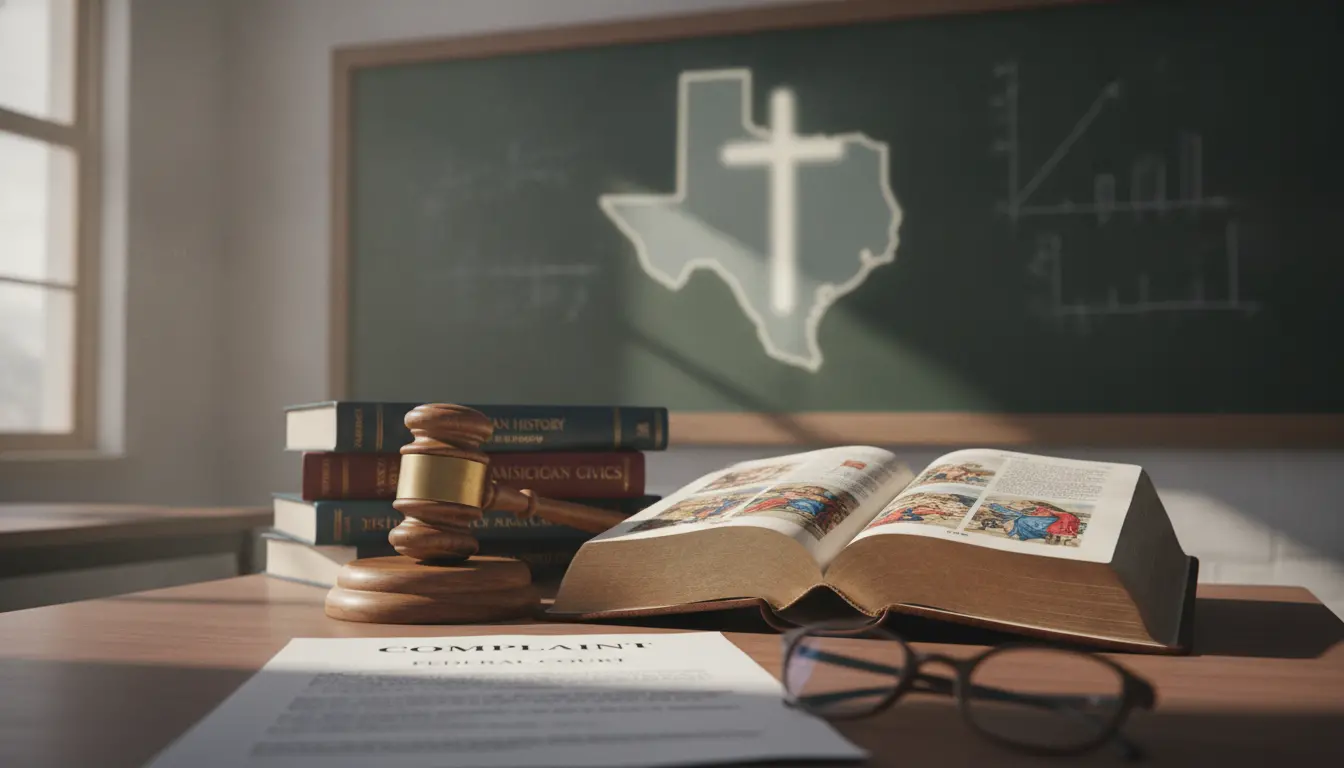
A recently enacted Texas law mandating the inclusion of Bible stories as a core curriculum component in public schools across the state has ignited a fierce constitutional debate and is poised to face immediate legal challenges in federal courts. The controversial measure, signed into law by Governor Greg Abbott, requires all public school districts to offer elective courses on the Old and New Testaments, making them a foundational part of the state's educational framework.Proponents argue the law promotes moral values and cultural literacy, while critics contend it directly violates the long-standing principle of separation of church and state, setting a dangerous precedent for religious instruction in secular institutions. This legislative move places Texas at the forefront of a national conversation regarding the role of religion in public education, drawing sharp lines between conservative religious advocacy and civil liberties groups.The new legislation, part of a broader conservative push in Texas, specifies that the elective courses must include, but not be limited to, an objective study of the Bible's historical and literary context, its influence on society, and its stories. While framed as elective, the law's mandate for all districts to offer these courses and integrate them into the core curriculum structure has raised concerns among educators and legal experts.The state's legislative process saw heated debates, with Republican lawmakers emphasizing the Bible's historical significance and its foundational role in Western civilization. They maintain that the curriculum is designed to be academic, not devotional, and thus does not infringe upon the First Amendment's Establishment Clause.However, opponents counter that the very nature of mandating such courses, regardless of intent, inherently promotes a particular religious viewpoint within a public school setting, creating an environment where non-Christian students or those from differing religious backgrounds may feel marginalized or pressured. The constitutional implications of the Texas law are significant, directly challenging the Establishment Clause of the First Amendment, which prohibits the government from establishing a religion.Landmark Supreme Court cases, such as Engel v. Vitale (1962) and Abington School District v.Schempp (1963), established precedents against state-sponsored prayer and Bible readings in public schools, affirming the separation of church and state in educational contexts. While the Supreme Court has allowed for the objective study of religion for academic purposes, the mandatory nature and explicit focus on Bible stories in the Texas law raise questions about whether it crosses the line from academic exploration to religious endorsement.Legal scholars point to the potential for curriculum drift, where courses initially designed for objective study can easily become vehicles for proselytization, especially given the diverse religious backgrounds of teachers and students. Civil liberties organizations and advocacy groups, including the American Civil Liberties Union (ACLU) of Texas and Americans United for Separation of Church and State, have swiftly condemned the law and are expected to file lawsuits in federal court.Their legal strategies will likely focus on arguing that the law constitutes governmental endorsement of religion, coerces religious participation, and creates an excessive entanglement between government and religion. They will seek an injunction to prevent the law's implementation, citing the potential harm to students' religious freedom and the integrity of a secular public education system.These challenges are anticipated to be robust, drawing upon decades of jurisprudence affirming the First Amendment's protections against state-sponsored religion in schools. The outcome will not only impact Texas but could also set a precedent or at least influence similar legislative efforts in other states with strong conservative political currents.What is at stake extends beyond the classrooms of Texas. The legal battle over this law could redefine the boundaries of religious instruction in public education nationwide, potentially inviting other states to pursue similar legislation or reinforcing the existing constitutional safeguards.For Texas students, the immediate future involves uncertainty regarding their curriculum, and for school districts, the prospect of navigating complex legal and educational challenges. The controversy underscores a persistent tension in American society between religious freedom and the principle of governmental neutrality towards religion, particularly within the public sphere. As the legal challenges unfold, the nation will watch to see whether federal courts uphold the state's right to mandate such curricula or reaffirm the constitutional wall of separation between church and state in public schools.
#hottest news
#Texas
#Public Education
#Religious Freedom
#Church and State
#Constitutional Law
#First Amendment
Stay Informed. Act Smarter.
Get weekly highlights, major headlines, and expert insights — then put your knowledge to work in our live prediction markets.
Related News
Comments
It's quiet here...Start the conversation by leaving the first comment.