

- News
- Politics
- China and Russia Launch Joint Naval Drills in Yellow Sea Amid Deepening Strategic Alignment
Politics
China and Russia Launch Joint Naval Drills in Yellow Sea Amid Deepening Strategic Alignment
MA
Mark Johnson
13 hours ago7 min read
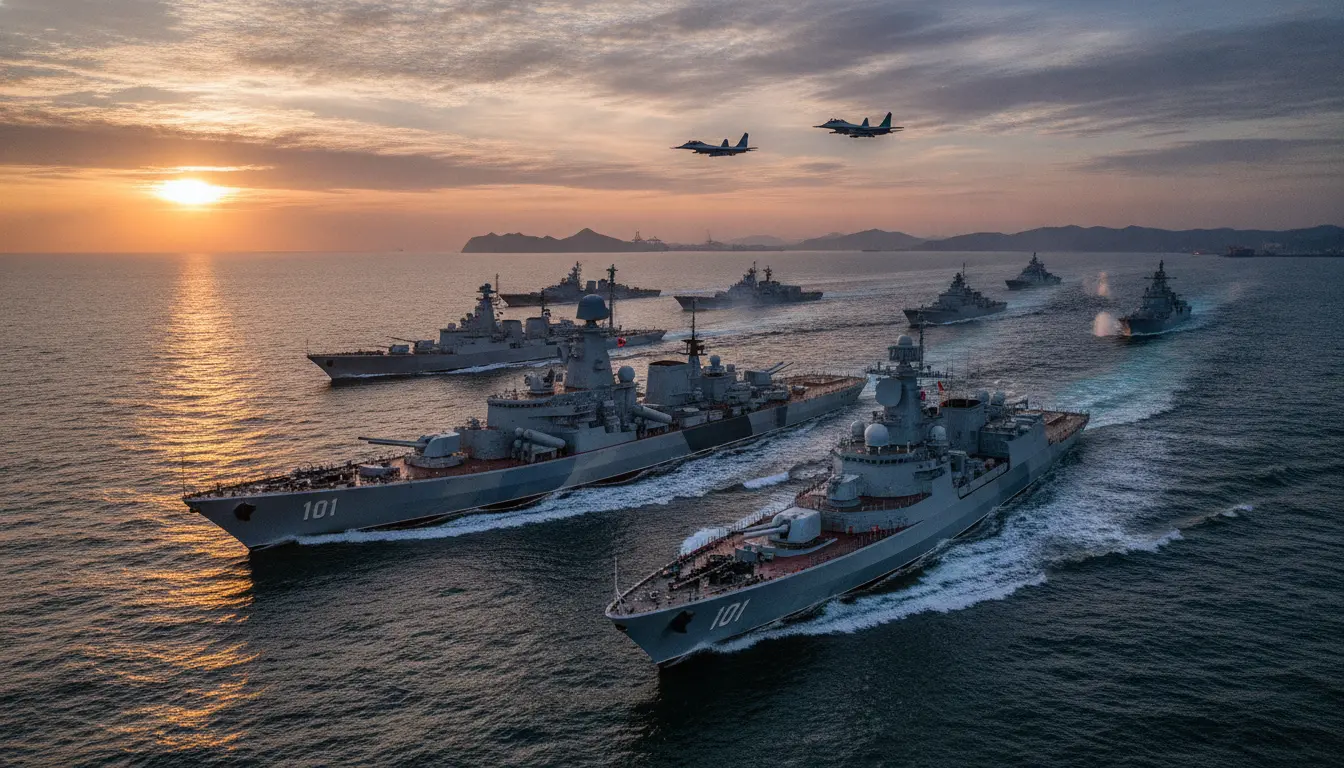
China and Russia have commenced their highly anticipated 'Joint Sea-2026' naval exercises, launching a series of coordinated drills from the port city of Qingdao in the Yellow Sea. The exercises, which began on July 5, 2026, are set to run for approximately ten days, concluding around July 15.These maneuvers represent a significant demonstration of the deepening military and strategic partnership between Beijing and Moscow, underscoring their shared commitment to enhancing maritime security and operational interoperability in an increasingly complex geopolitical landscape. The 'Joint Sea' exercises have become a hallmark of China-Russia military cooperation, evolving in frequency and complexity over the past decade.Initiated against a backdrop of intensifying competition with Western powers, particularly the United States, these drills serve as a practical manifestation of the "no-limits" partnership declared by Presidents Xi Jinping and Vladimir Putin. The choice of Qingdao, a major naval base for China's North Sea Fleet, is strategically significant, placing the exercises in a vital maritime zone close to the Korean Peninsula and Japan, nations with close ties to the US.This location sends a clear signal about the two powers' growing ability to project influence and coordinate operations in key regional waters. Official statements from both Beijing and Moscow emphasize the defensive nature of the drills, focusing on improving joint command and control, anti-submarine warfare, air defense, and maritime search and rescue operations.While the precise scale of vessels and personnel involved remains under wraps, previous iterations of 'Joint Sea' exercises have typically included a formidable array of destroyers, frigates, submarines, support vessels, naval aviation, and marine corps units. These exercises are not merely about showcasing hardware; they are critical for refining tactics, standardizing communication protocols, and fostering a deeper understanding between the two navies, aspects essential for any effective military alliance or partnership.From a broader geopolitical perspective, these exercises are widely viewed as a direct response to perceived Western aggression and a counterbalance to alliances such as AUKUS and the Quadrilateral Security Dialogue (Quad). They project an image of a united front capable of challenging the US-led international order and demonstrating an alternative vision for global security.The timing, amid ongoing tensions in Eastern Europe and concerns over potential flashpoints in the Indo-Pacific, further amplifies their symbolic and practical importance. Observers in Washington, Tokyo, and Seoul are undoubtedly scrutinizing every detail, assessing the implications for regional stability and their own defense postures.The 'Joint Sea-2026' drills also highlight Russia's enduring military relevance in the Indo-Pacific, despite its primary focus on the conflict in Ukraine. By participating in these high-profile exercises, Moscow signals its continued strategic partnership with Beijing and its capacity to maintain a global naval presence.For China, these joint operations are invaluable for gaining experience from Russia's more seasoned navy, particularly in areas like long-range logistics and complex multi-domain operations, even as China rapidly modernizes its own forces. The collaborative learning process is mutually beneficial, strengthening both nations' naval capabilities and their ability to operate effectively in diverse maritime environments.As the exercises proceed towards their scheduled conclusion, the world watches closely to discern the evolving dynamics of this crucial partnership. Beyond the tactical training and strategic messaging, the 'Joint Sea-2026' drills fundamentally reshape expectations about naval cooperation between major powers.They cement the perception of a formidable, coordinated challenge to prevailing global security frameworks and hint at a future where such joint demonstrations of force become a more regular feature of international relations, especially in contested maritime zones. The implications for regional alliances and the balance of power will resonate long after the ships return to port.
#featured
#China
#Russia
#Naval Exercises
#Joint Sea-2026
#Geopolitics
#Military Cooperation
#Qingdao
#Yellow Sea
Stay Informed. Act Smarter.
Get weekly highlights, major headlines, and expert insights — then put your knowledge to work in our live prediction markets.
Related News



Comments
It's quiet here...Start the conversation by leaving the first comment.